
Indonesia draws foreign interest for its scale and growth story, but projects can slip when stakeholders are misread or engaged too late. U.S. government sources describe Indonesia as attractive to investors because it has a population of 283 million and a relatively stable economy valued at $1.4 trillion, while also noting that investing remains challenging for business contacts. That tension is the practical starting point for government relations work in Indonesia: opportunity sits beside restrictive regulations and legal and regulatory uncertainty. A structured stakeholder map helps teams connect their project narrative to what decision-makers are prioritizing, and it reduces the risk of treating government engagement as a last-minute permit chase.
Getting the policy context right matters because the investment framework has been changing. The 2020 Omnibus Law on Job Creation, revised and enacted in March 2023, is described as improving competitiveness by lowering corporate taxes, improving labor flexibility, and reducing some bureaucratic and regulatory barriers. At the same time, Indonesia eliminated its Negative Investment List in 2021 and opened numerous sectors to foreign investment. Yet the same sources underline that challenges remain, including restrictive regulations and uncertainty. For foreign project teams, this means stakeholder mapping must include not just “who issues the permit,” but also who shapes the interpretation of rules as they evolve.
A Practical Stakeholder Map: From Palace-Level Signals to District Execution
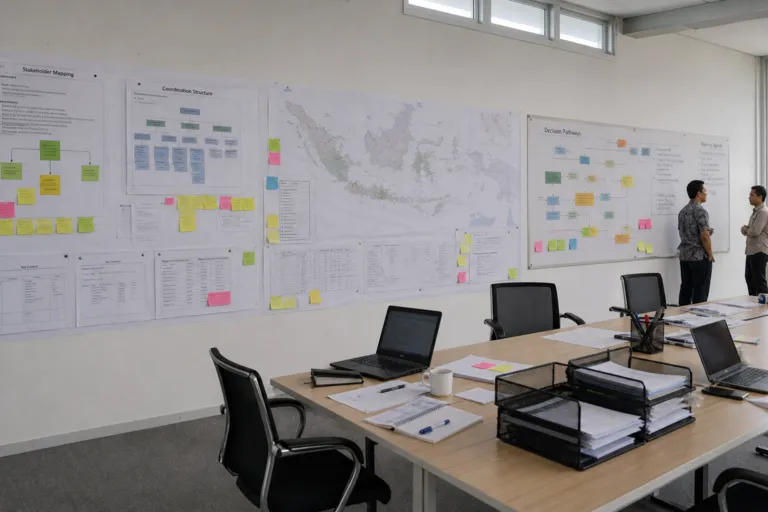
Effective engagement increasingly requires coordination from the presidential and coordinating level through sectoral ministries, investment institutions, and regulators, while maintaining strong relationships with provincial and district governments. This layered view is emphasized by practitioners who argue government relations should not be limited to approvals, but should position projects within political and economic priorities. Mapping stakeholders by influence helps clarify sequencing: who sets the direction, who translates it into implementing regulations, and who controls day-to-day execution. Local stakeholders stay critical for implementation, community acceptance, and operational continuity, so a map that ends in Jakarta can miss the actors who decide whether a timeline holds.
Sector context should shape the map. For energy, mining, and natural-resource projects, the Minister of Energy and Mineral Resources, Bahlil Lahadalia, is described as central as the government tightens oversight of mining licenses while pursuing downstream development and energy security. The Coordinating Minister for Economic Affairs, Airlangga Hartarto, is described as playing a key role in cross-ministerial economic policy, particularly on macroeconomic, trade, and investment-related issues. Separately, trade guidance notes that Indonesia continues to prioritize industrial policies encouraging domestic processing of natural resources, often referred to as “down streaming,” which can change who inside government becomes most influential for project decisions.
Stakeholder mapping also benefits from anchoring engagement in measurable national priorities. Trade guidance states Indonesia’s GDP was around $1.46 trillion in 2024 and that growth stabilized at around 5.0 percent in 2023 and in 2024. It also notes approximately $145 billion in foreign reserves as of early 2025. Under President Prabowo Subianto, sources describe ambitions to accelerate economic growth to eight percent annually by 2029, alongside a $19.1 billion reduction in the 2025 state budget and a plan to increase the revenue-to-GDP ratio from 12 percent to 23 percent by improving tax collection efficiency. A clear government relations Indonesia plan can tie a project’s outcomes to these stated goals, while still preparing for trade and investment barriers such as local content requirements and restrictive non-tariff measures.
Why does stakeholder mapping matter for foreign projects in Indonesia?
Which levels of government should a stakeholder map include?
Who are key stakeholders for energy and mining engagement?
What policy signals should a government relations strategy track in Indonesia?
How does government relations in Indonesia keep projects on track?