
Building an Indonesia supply chain risk assessment program now requires scenario thinking, not just audits. In May 2026, Indonesia recorded a trade deficit of USD 1.61 billion, described as the first in six years, amid an energy import surge linked to Strait of Hormuz disruption risk, a commodity export slowdown, and a rupiah depreciation cycle that makes imported dollars progressively more expensive. In the same month, Reuters-confirmed figures cited a USD 3.76 billion oil and gas sector deficit, with Pertamina prioritizing domestic refineries at the expense of crude oil exports. For procurement teams, those signals matter because they change lead times, prices, and contract enforceability at the same time, rather than one risk at a time.
Policy is another stress variable buyers have to model explicitly. President Prabowo Subianto announced a DSI framework on May 20, 2026, requiring exports of strategic natural resources, beginning with palm oil, coal, and ferroalloys, to go through designated state-owned enterprises as sole exporters. The same briefing describes this single-gate architecture as a chokepoint that creates contract-enforceability risk and unresolved pricing mechanics for long-term buyer relationships. Indonesia Investments also reported the non-oil and gas surplus contracted 63.2% year-on-year, as Government Regulation No. 24 of 2026 introduced administrative bottlenecks across palm oil and coal export chains. Separately, analysis of export restrictions highlights that bans and controls can target product form, not only volumes, reshaping negotiation leverage and delivery assumptions for downstream buyers.
How to Stress-Test Indonesian Suppliers for Energy, FX, and Policy Shocks
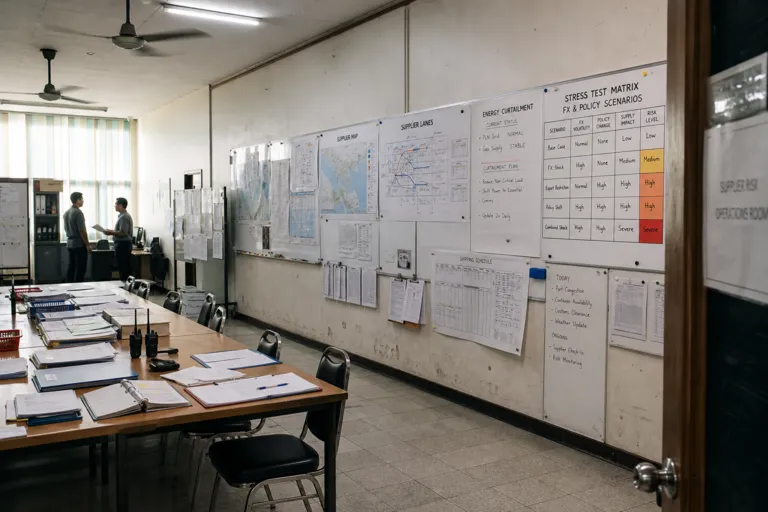
A practical approach is to use a structured stress-testing framework: build a baseline network model, apply “what-if” shocks, and measure performance in service, cost, and recovery time. The framework explicitly includes energy price spikes, currency moves, and regulatory change, and it recommends tracking how shocks transmit through capacity losses, lead-time extensions, allocation restrictions, and substitution constraints. For Indonesia exposure, scenario design should include correlated, multi-node shocks, such as a port disruption combined with fuel pressure and a policy shift that changes who can legally export. Response levers in the same framework include inventory drawdown and repositioning, alternate routing, expediting, cross-plant flexibility, second-source activation, demand shaping, and temporary product substitutions.
Critical minerals supply chains add concentration risk that should be quantified, not assumed away. The National Bureau of Asian Research documented that, between 2014 and 2023, more than 30 nickel smelters were constructed, primarily in Central Sulawesi and North Maluku. That geographic clustering can be economically efficient, but it also creates systemic risk when disruptions are regional. Market-access risk can compound operational risk. A policy paper on Indonesia’s critical minerals warns that governance in environmental and social dimensions can create market access risks through Non-Tariff Measures as EV manufacturers increasingly require low-carbon and ESG-compliant supply chains, not only in the EU but also in China. In stress tests, that means adding a “market access constraint” branch to scenarios, not just production downtime.
Finally, stress tests should reflect how shocks show up domestically and regionally through logistics and prices. An October 2026 logistics-focused OpEd noted consumer prices in North Sulawesi were 8.07% higher than a year earlier, while Jakarta’s figure was 2.52%, underscoring that shock absorption can vary sharply by location. For cross-border buyers, export-policy ambiguity can also move benchmarks: one analysis warns Indonesian thermal coal grades serve as reference points for procurement across Japan, South Korea, and India, and that systematic divergence between state enterprise quoted prices and underlying supply-demand conditions would have region-wide consequences. The goal is not to predict one outcome, but to prove your supplier portfolio can survive combined energy, FX, and policy shocks without cascading failures.
What should an Indonesia supply chain risk assessment focus on right now?
Which export-policy changes create supplier and contract risk for buyers?
How can companies model correlated shocks instead of single events?
Why does nickel processing concentration matter for resilience planning?
What local signal suggests shocks can transmit unevenly inside Indonesia?