Indonesia’s energy transition financing pipeline increasingly relies on labeled instruments that sit at the intersection of sustainability and Islamic finance. The country pioneered sovereign green sukuk and issued its first sovereign Green Sukuk in 2018 at USD 1.25 billion, following the establishment of the Green Bond & Sukuk Framework in 2017. In regional context, a review of ASEAN green finance highlights that Indonesia mobilized funds through this structure for renewable-energy projects, climate-resilient infrastructure, and sustainable transportation, while also noting the practical challenge of scaling issuance beyond sovereign bonds. These instruments matter because they connect project spending to public reporting, allowing investors to track where proceeds are being allocated and what outcomes are being claimed.
Across recent years, the market signals in reporting are about both scale and investor demand. One academic assessment using official Green Sukuk Allocation and Impact Reports published from 2019 to 2025 states that global issuance reached USD 6.60 billion and domestic issuance reached IDR 71.77 trillion by 2024. Separately, a frontier-markets sustainable finance analysis describes Indonesia’s green sukuk as consistently attracting oversubscriptions of 3x to 5x, and associates that demand with a pricing “greenium” of 15 to 20 basis points below conventional sovereign yield curves. A broader ASEAN energy-finance review adds another datapoint, stating that by 2024 Indonesia had more than doubled its sukuk issuance to USD 2.35 billion, citing the Ministry of Finance.
What the Allocation Mix Says About the Transition
Allocation details are where the energy-transition story becomes more nuanced. The maqasid-based assessment explicitly separates direct clean-energy financing from adaptation-oriented green infrastructure to test transition intensity. Using its indicators, it reports a Core Clean-Energy Ratio of 8.93% across the cumulative allocation portfolio, rising to 30.54% when sustainable transport is included. In the same breakdown, water and climate resilience account for 69.19%, showing that adaptation-oriented categories remain the majority share in the reported portfolio. The study also cautions that actual impacts and expected impacts are not interchangeable, even when project reports show measurable benefits such as solar generation and reported transport emission reductions.
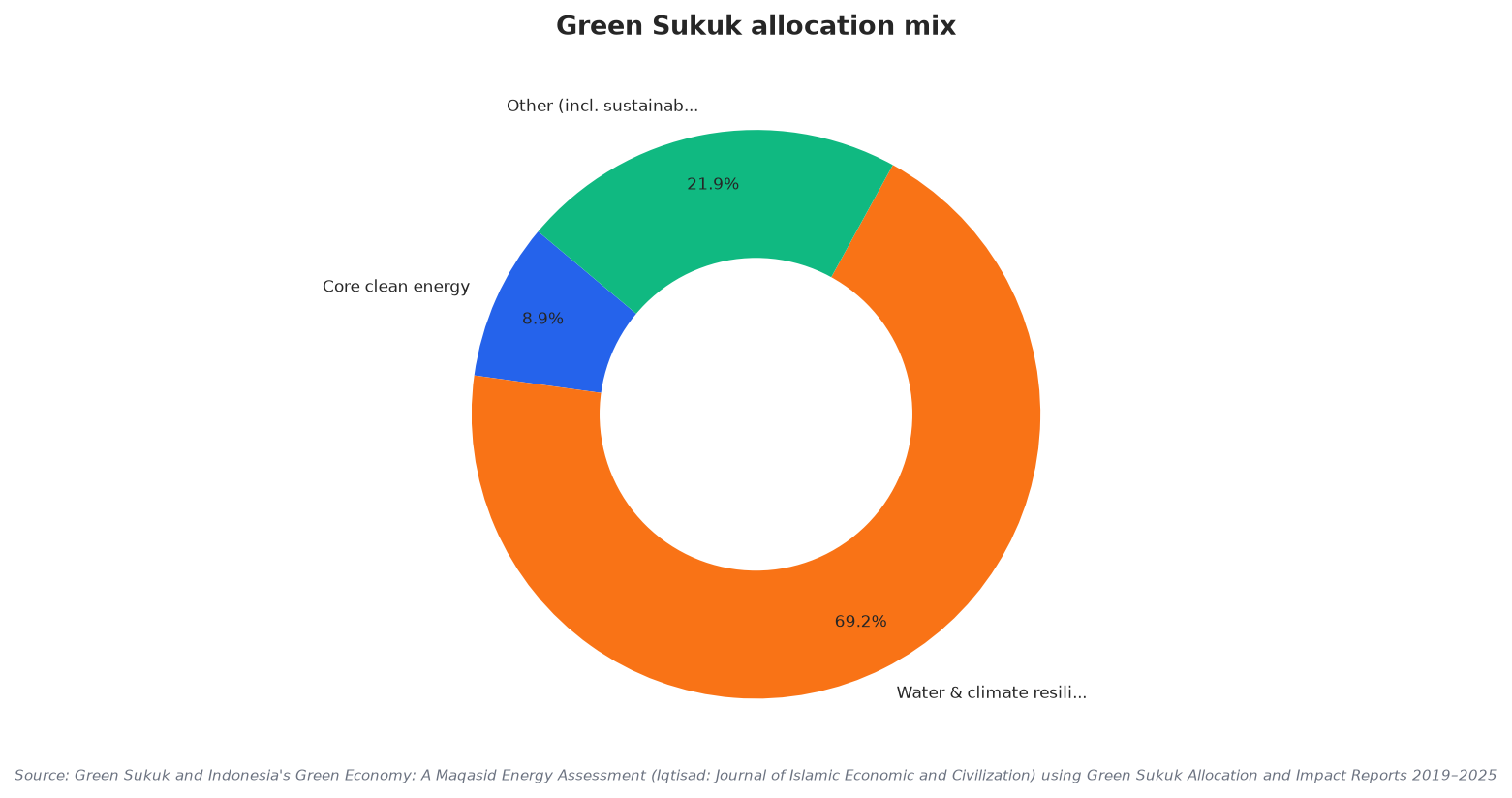
For policy and market design, this portfolio mix implies a dual mandate: preserve adaptation finance while increasing the pipeline of bankable clean-energy projects that can absorb more labeled capital. The assessment recommends expanding comparable impact disclosure, which matters because green sukuk credibility is tightly linked to allocation and impact reporting. Meanwhile, an analysis of frontier green bonds emphasizes how Indonesia’s sovereign structure taps two non-correlated pools of capital—Western dedicated ESG funds and Middle Eastern Sharia-compliant institutional investors—supported by a Wakalah sukuk structure backed by state transport and renewable assets and dual listing in Singapore and Jakarta. This combination helps explain repeated oversubscription alongside reported pricing advantages.
Indonesia’s labeled finance ecosystem also sits alongside other transition funding channels that can complement sovereign issuance. A discussion of blended finance and de-risking notes that the World Bank approved a USD 2.13 billion financing package dedicated to sustainable growth and the clean energy transition. The same source highlights a €7.82 million grant agreement with KfW Development Bank to establish a Green Bond Development Facility aimed at accelerating domestic green bond issuances. Put together, these elements show a pathway where the sovereign instrument sets standards and investor familiarity, while de-risking platforms and domestic bond facilities can help broaden the market beyond the sovereign balance sheet, which multiple sources flag as the key scaling challenge.
How much has Indonesia’s sovereign green sukuk issuance reached by 2024?
What share of the portfolio is directly clean energy versus adaptation-focused spending?
What investor-demand signals are reported for Indonesia’s green sukuk?
How does the Indonesia green sukuk approach connect to broader sustainable bond development?
Why do sources say impact reporting needs caution in interpreting results?