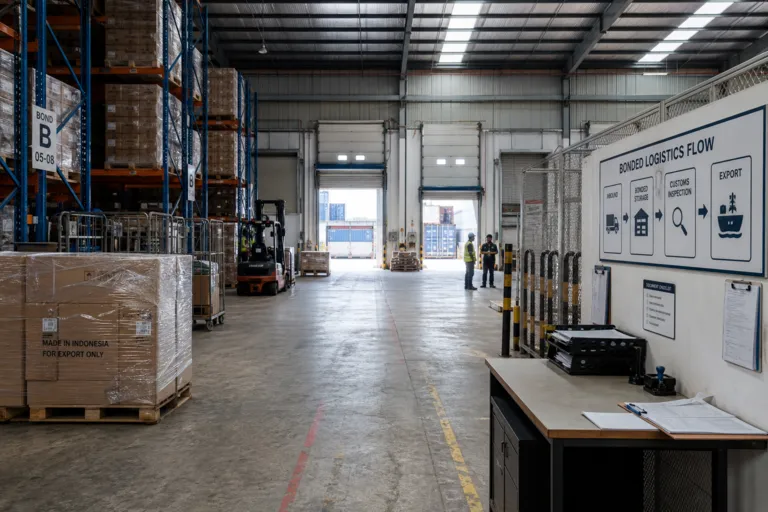
Exporters weighing a bonded zone versus a Special Economic Zone (SEZ/KEK) are really choosing between two incentive instruments. A bonded zone is a customs-controlled facility where imported goods can be stored, manufactured, or processed while import duties and taxes are suspended until goods are released into Indonesia’s domestic market. This can reduce pressure on working capital because duties are not paid upfront on imported inputs that stay in the facility or are re-exported. Bonded zones are also positioned near ports, airports, and industrial clusters to reduce logistics costs and speed up customs processes, with examples including Batam, Cikarang, Tangerang, Surabaya, and Semarang.
In practice, these customs-driven benefits can be especially relevant when your production is export-focused. Indonesian Customs told Antara in August 2025 that there were 1,512 active bonded zone companies, and that bonded zones accounted for 27.94% of national exports. For exporters, that scale matters because it signals an established operating model and a large peer set already using similar mechanisms. Research focused on manufacturing firms receiving bonded-zone fiscal facilities over the 2019–2024 period found that fiscal incentives improve companies’ export performance. The same study also reported that inflation rates have a positive effect on export performance, aligning with prior findings referenced in the paper.
How SEZ (KEK) Incentives Differ From Bonded-Zone Facilities
An SEZ (KEK) is a designated geographic territory that can bundle a broader package than a bonded zone. One plain-English comparison notes that the KEK framework provides customs-duty suspension and VAT non-collection inside the zone, plus a corporate income tax (CIT) holiday of 10 to 20 years. The same source stresses a key distinction for decision-making: a bonded zone is a customs-control instrument applied to a specific facility and provides suspension of import duties and VAT on inputs until they exit to the domestic market, but it provides no CIT holiday. In other words, SEZs can add corporate tax tools that bonded zones do not, but only if your business model fits the SEZ framework and approvals.
SEZs also tend to be more “sector-aligned” in how incentives are applied. Since 2009, the government has established 24 SEZs across Indonesia, with 20 fully operational and the rest in development, spanning sectors including healthcare, education, manufacturing, tourism, and entertainment. One investor-oriented comparison notes that the most substantial incentives are typically reserved for investors whose activities align with the SEZ’s focus. It also highlights that incentives are not automatic and that SEZ operations connect to IT inventory requirements integrated with the Indonesian National Single Window (INSW) and customs and tax computer service systems, which can add compliance steps for some operators.
So when do Indonesia bonded zone incentives make more sense than an SEZ package? A good fit is an exporter that mainly needs import-duty and tax suspension on inputs, wants a facility-level instrument rather than relocating into a broader geographic KEK, and expects to re-export most output. A practical constraint to plan around is domestic sales: bonded-zone sales into the domestic market are normally limited to 50% of the previous year’s export and related sales. If your strategy requires large domestic sell-down, an SEZ or another structure may deserve a closer look. As always, incentives can apply case-by-case, so confirm the pathway through official systems and channels.
What is a bonded zone in Indonesia, in practical terms for exporters?
How large is the bonded-zone scheme in Indonesia?
What do SEZ (KEK) incentives add that bonded zones do not?
When do Indonesia bonded zone incentives make more sense than going into an SEZ?
How many SEZs has Indonesia established, and are they all operating?