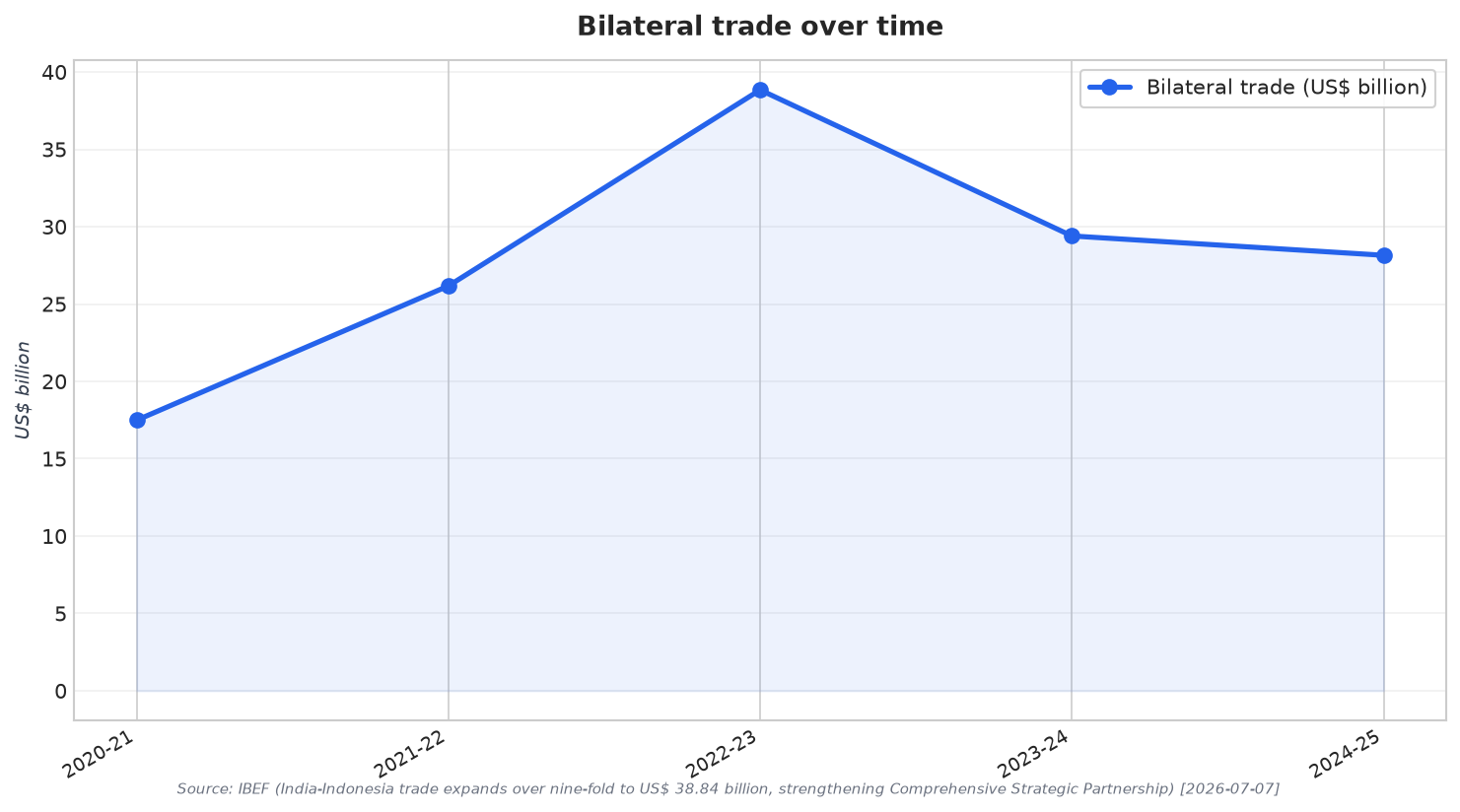
Indonesia and India have built a much bigger commercial corridor over the past two decades. Bilateral trade rose from Rs. 19,040 crore (US$ 4.30 billion) in 2005-06 to Rs. 3,12,235 crore (US$ 38.84 billion) in 2022-23, according to IBEF. More recently, total trade moderated to Rs. 2,43,432 crore (US$ 29.40 billion) in 2023-24 and Rs. 2,39,275 crore (US$ 28.15 billion) in 2024-25. For April 2025 to February 2026, it already reached Rs. 2,00,777 crore (US$ 22.72 billion). The corridor is still shaped by commodities, but the direction of travel is toward a broader, more integrated partnership.
Coal and palm oil remain the anchor lines. IBEF notes India is the second-largest buyer of Indonesian coal and the largest importer of Indonesian crude palm oil, alongside sourcing minerals, rubber, hydrocarbons, pulp, and paper. From the Indonesian side, All Frontier Global puts 2023 corridor totals at US$ 27.0 billion, with Indonesian exports of US$ 20.3 billion and imports of US$ 6.7 billion, leaving an Indonesian surplus of US$ 13.6 billion. The same source says coal and palm oil are the top two Indonesian export lines. In India’s 2024-25 trade with Indonesia, exports were Rs. 45,730 crore (US$ 5.38 billion) versus imports of Rs. 1,93,630 crore (US$ 22.78 billion), reinforcing the large merchandise deficit on India’s side.
Beyond Commodities: Pharma and Autos Move Up the Agenda
The mix is still evolving, and that is where new opportunities show up. CNBC TV18 highlights export diversification on India’s side: refined petroleum fell from 39% to 5% of exports, while frozen bovine meat, auto components, and unmanufactured tobacco gained ground. IBEF also lists Indian exports that fit an industrial-upgrading narrative, including commercial vehicles, telecommunications equipment, steel products, plastics, and refined petroleum products. On healthcare, multiple sources point to pharmaceuticals as a practical next wave. All Frontier Global states India exports pharmaceuticals in bulk and formulations to Indonesia, while Tradebrains describes India supporting industrial and healthcare sectors in Indonesia with organic chemicals and pharmaceuticals.
Indonesia’s export profile helps explain why industrial cooperation matters, not just commodity shipping. TradeInt’s Indonesia export data for January to October 2025 shows palm oil and its fractions (HS 1511) at US$ 20.20 billion and coal and briquettes (HS 2701) at US$ 20.09 billion, with ferroalloys (HS 7202) at US$ 13.35 billion. Over the same period, India was a major destination for Indonesian exports at US$ 15.33 billion (6.60% share), with TradeInt describing strong trade in coal and palm oil. This context supports a pivot: as trade volumes rise, the next step is building more two-way value in sectors like auto supply chains and pharmaceuticals, not only scaling raw-material flows.
Investment and connectivity can help the shift stick. IBEF reports Indian companies invested Rs. 14,884 crore (US$ 1.56 billion) across 7,292 projects in Indonesia between 2000 and 2024, while Indonesia’s cumulative investment in India reached Rs. 6,377 crore (US$ 668.37 million) from January 2000 to September 2025. IBEF also says around 100 Indian companies and joint ventures operate in Indonesia across diverse sectors. Connectivity has expanded too, with Air India increasing Delhi–Bali services from seven to 10 weekly flights, and four direct routes now linking the countries: Jakarta–Mumbai, Bali–Bengaluru, Bali–Mumbai, and Bali–Delhi. In 2024, 7.1 lakh Indian visitors travelled to Indonesia, adding more day-to-day links that can support deal flow.
How has Indonesia–India trade changed over time?
What still dominates the Indonesia–India trade corridor?
What do the 2024-25 numbers say about the trade balance?
Where do pharmaceuticals and autos fit into the opportunity set?
What investment and connectivity signals support deeper Indonesia India trade ties?