ASEAN’s Digital Economy Framework Agreement (DEFA) is poised to become a region-wide agreement focused exclusively on digital economy governance. Rather than embedding digital rules inside broader trade deals, DEFA is designed as a dedicated framework to harmonize digital trade rules, enable trusted cross-border data flows, and build coherent regulations for paperless trading, e-commerce, cybersecurity, and digital payments across ASEAN. Negotiators finished DEFA negotiations on 29 May 2026, and the pact is expected to be signed at an ASEAN Summit in November 2026, when leaders from the bloc’s 11 member states assemble in Manila. The intent is clear: make cross-border digital business more predictable across multiple jurisdictions.
The economic framing behind DEFA is ambitious, but the sources also emphasize practical execution. ASEAN’s digital economy is described as currently valued at around $300 billion, projected to reach $1 trillion by 2030, and potentially double to $2 trillion with successful DEFA implementation. Another benchmark cited for context estimates the region’s digital economy exceeded $300 billion in gross merchandise value in 2025. For Indonesia specifically, the region’s largest digital economy is described at a $90 billion valuation in 2024, with reporting that it could triple to $360 billion by 2030, including $150 billion from e-commerce. These figures set expectations, but they also raise the bar on implementation, enforcement, and interoperability across all 11 markets.
What Cross-border Companies Should Expect in Practice
For cross-border operators, the biggest near-term value is standardization. One CSIS commentary highlights the problem DEFA is trying to solve: regulatory heterogeneity across ASEAN member states has imposed an estimated $15–20 billion in annual compliance costs on businesses operating across the region. The World Economic Forum also stresses that DEFA’s significance for micro, small, and medium enterprises (MSMEs) should be measured in the marginal cost of entering a second, third, or fourth ASEAN market, not only in trade totals. MSMEs comprise about 97% of ASEAN companies and account for roughly 85% of employment, and ASEAN has 71 million MSMEs that struggle to navigate conflicting national rules.
In that light, DEFA’s promise for Indonesia-linked sellers and service providers is a simpler playbook for cross-border operations. The World Economic Forum offers a concrete example: an online Indonesian batik maker could use a unified ASEAN e-invoicing and customs system under DEFA to sell across borders with minimal paperwork. The pact’s scope is described as covering data governance, digital identity, e-payments, online safety, cybersecurity standards, and even “emerging technologies including artificial intelligence” added to future-proof the agreement. That combination targets day-to-day friction: onboarding, transaction trust, payment acceptance, and documentation that repeats in each market.
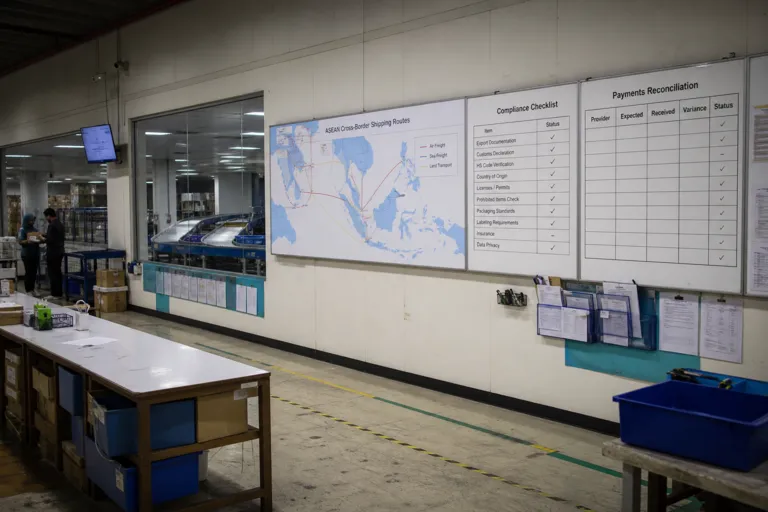
At the same time, companies should plan for a transition period where national rules keep moving. A logistics-focused briefing notes ASEAN concluded DEFA on 29 May 2026 and plans to sign it at the Manila summit from 16 to 18 November. It also highlights a tougher operating environment for parcels: Thailand taxes online imports from 1 baht, Indonesia keeps a $100 per-unit price floor for cross-border goods, and Vietnam introduced Circular 142 with electronic parcel declarations and recipient identification starting 16 November. This is where the keyword topic of ASEAN DEFA Indonesia becomes practical: DEFA may harmonize regional digital rules, but firms still need to design compliance, origin evidence, and data quality processes that work country by country while convergence takes hold.
When was ASEAN DEFA concluded and when is it expected to be signed?
What business areas does DEFA aim to standardize across ASEAN?
What do the sources say about the cost of fragmented digital regulations in ASEAN?
How big is Indonesia’s digital economy in the DEFA discussion, and what is projected?
What could ASEAN DEFA mean for Indonesia-centered cross-border business expansion?