Rigorous commercial due diligence is an independent assessment of a target’s commercial viability before an acquisition or investment. It tests the commercial reality behind the investment thesis, including market opportunity, competitive position, pricing power, customer relationships, and growth risk before capital is committed. One source attributes 55% of deal underperformance to commercial factors that were underestimated or missed during diligence, which is why deal teams focus on evidence, not narrative. In its most rigorous form, the work blends secondary research such as market data, competitive intelligence, and industry analysis with primary research: independent interviews with the target’s actual customers, conducted without management’s knowledge or involvement.
For an Indonesian target, process design matters because public data can be limited for private companies. One Indonesia-focused legal due diligence guide notes that publicly available data on Indonesian private companies is limited. It says the Directorate General of Legal Administration system provides basic information such as capital structure, shareholders, and board composition, but deeper diligence requires direct document requests from the target company. While legal and commercial diligence are different workstreams, this constraint affects how you plan commercial fact-finding, timelines, and document requests. The same guide adds that most documents are in Bahasa Indonesia and that accurate interpretation requires qualified legal practitioners who understand local terminology, not just translation software.
The Core Tests: Market, Customers, Competition, and Scenarios
Market analysis is the backbone of commercial due diligence. Analysts test how the target defines its market, including category boundaries and segment logic, and then validate whether opportunity claims reflect realistic demand conditions. A rigorous program asks whether demand is real, durable, and scalable by evaluating need, willingness to pay, and adoption drivers across segments. In one set of research figures, 49% of customers cite unmet needs or dissatisfaction with current solutions, while 27% of projected growth is tied to assumptions that require significant behavior change or market education. The point is not to accept a growth story at face value, but to isolate which parts depend on fragile adoption assumptions.
Customer analysis then stress-tests the durability of revenue. Commercial diligence breaks the customer base into meaningful groups and examines industry exposure, company size distribution, geographic spread, and use case differences that influence retention stability. It also checks whether the target serves profitable segments, and whether loyalty and demand claims hold up under scrutiny. A common failure, according to one guide, is compressing customer evidence into only 5–10 reference calls with customers hand-picked by management, which becomes “narrative confirmation” rather than diligence. A more defensible approach uses independent outreach to actual users and buyers so the deal team can judge whether customers will continue to pay, pay more, or leave.
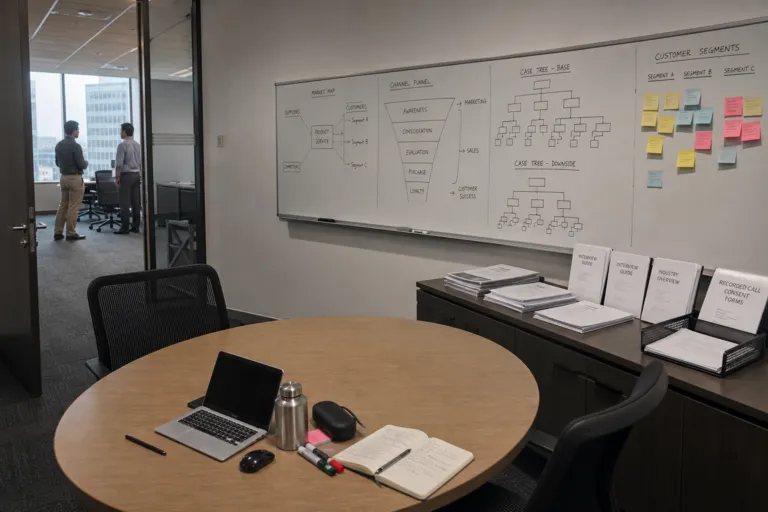
Competitive assessment and scenario building convert insight into deal action. Diligence evaluates competitive intensity, switching behavior, and differentiation to understand how sustainable performance is under pressure. One set of findings reports that 43% of buyers say alternative providers could meet their needs with minimal switching friction, and 31% associate a company’s advantage primarily with execution rather than structural differentiation. Analysts then build base and downside cases, stress-testing churn sensitivity and pricing compression to quantify impact on cash flow stability and expose structural weakness. This is where commercial due diligence in Indonesia becomes especially valuable: it creates a disciplined, evidence-backed view that informs valuation, integration planning, and protections in the final terms.
What does rigorous commercial due diligence include before acquiring a target?
Why is customer evidence treated as the differentiator in commercial diligence?
What makes commercial diligence harder when the target is in Indonesia?
What buyer signals can reveal competitive risk during diligence?
How should a deal team approach commercial due diligence for an Indonesian acquisition?