EU demand still matters for palm oil used in food, cosmetics, biofuels, and industrial applications, but the compliance bar is rising. The European Union Deforestation Regulation (EUDR) was introduced in 2023 and sets December 31, 2020 as the deforestation cutoff date for legal EU sales of palm oil linked to forest conversion. One analysis described full enforcement by December 2026, and another notes an implementation timeline where large companies must comply by December 30, 2026, while micro and small enterprises have additional time until June 30, 2027. This creates a near-term sprint for exporters who want to protect Indonesia palm oil EU market access, especially when evidence must be complete and verifiable, not informal.
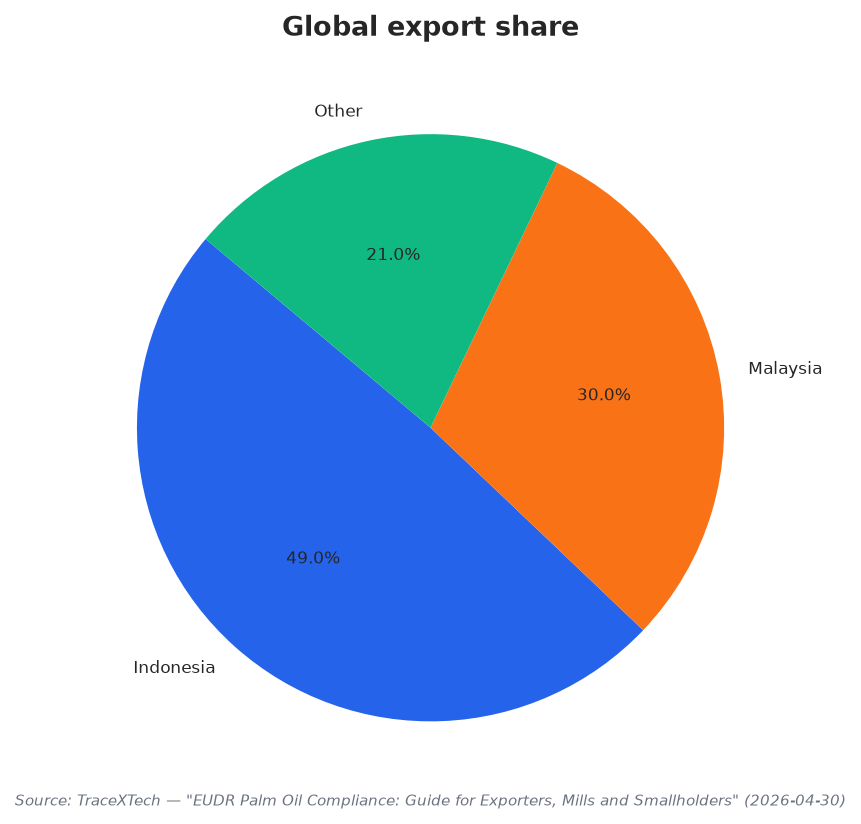
Indonesia’s position in global supply is large, which makes EU compliance a strategic issue rather than a niche requirement. A compliance guide states Indonesia accounts for 54% of global palm oil production and 49% of exports, while Malaysia accounts for 28% of production and 30% of exports; together they represent roughly 80% of global palm oil. Another source says Indonesia and Malaysia make up over 80% of global production and about 90% of exports, with worldwide palm oil exports reaching 38 million metric tons in 2021/22. Because so much volume is routed through complex networks, even a small documentation failure can block EU entry at shipment level.
EUDR Due Diligence: Why Traceability Breaks at Agents and Mixed Lots
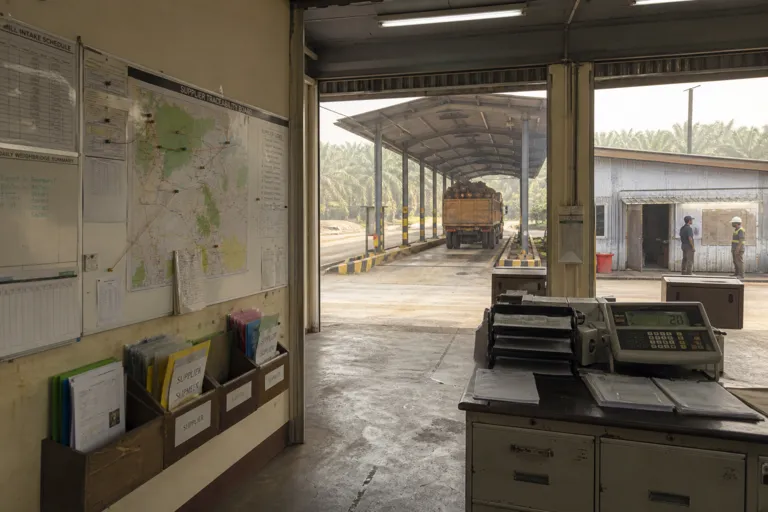
Under EUDR, each shipment placing or making palm oil available on the EU market needs its own due diligence statement (DDS), with no blanket approval. Mixed-origin lots are treated as non-compliant by default when non-compliant fruit cannot be separated and identified, pushing exporters to digitize agent collection so every delivery is logged by farm source. This is difficult in practice because palm oil supply chains often involve many intermediaries before products reach processors or exporters. In Indonesia, mills can rely on large traders working with multiple sub-agents, which makes the Fresh Fruit Bunches (FFBs) trail hard to reconstruct after the fact.
The burden is not evenly distributed. One guide highlights that independent smallholders in Indonesia and Malaysia operating plots under 5 hectares often lack smartphone access and operate through agents who do not collect digital records, yet they are asked for polygon-level geolocation, legality documentation, and deforestation-free proof. At the same time, the EU Commission classifies countries into low, standard, and high-risk tiers based on deforestation rates; Indonesia and Malaysia are described as standard risk, so full due diligence is still required, even if simplified procedures may apply for some operators. The compliance goal is clear, but the practical constraint is data completeness across thousands of small transactions.
Compliance is also becoming a technology race. The global EUDR commodity due-diligence software market is valued at USD 1.1 billion in 2026 and is forecast at USD 1.8 billion by 2036, growing at a 5.2% CAGR. In that same report, the market’s segment shares are described as 35% for coffee, 35% for palm oil, and 30% for cocoa, reflecting broad adoption pressure as enforcement and penalties strengthen. It also notes palm oil traders accelerated software adoption, particularly those sourcing from Indonesia and Malaysia, where plantation boundaries often overlap with protected forest areas. For exporters, the path to EU continuity increasingly looks like auditable geolocation, automated risk assessment, and DDS-ready recordkeeping that can withstand scrutiny.
What is the EUDR deforestation cutoff date for palm oil sold into the EU?
When do companies need to be ready for EUDR compliance deadlines?
Why can mixed-origin palm oil shipments fail EUDR checks?
What makes Indonesia’s palm oil supply chain hard to document for the EU?
How can Indonesia protect palm oil access to the EU market under EUDR rules?