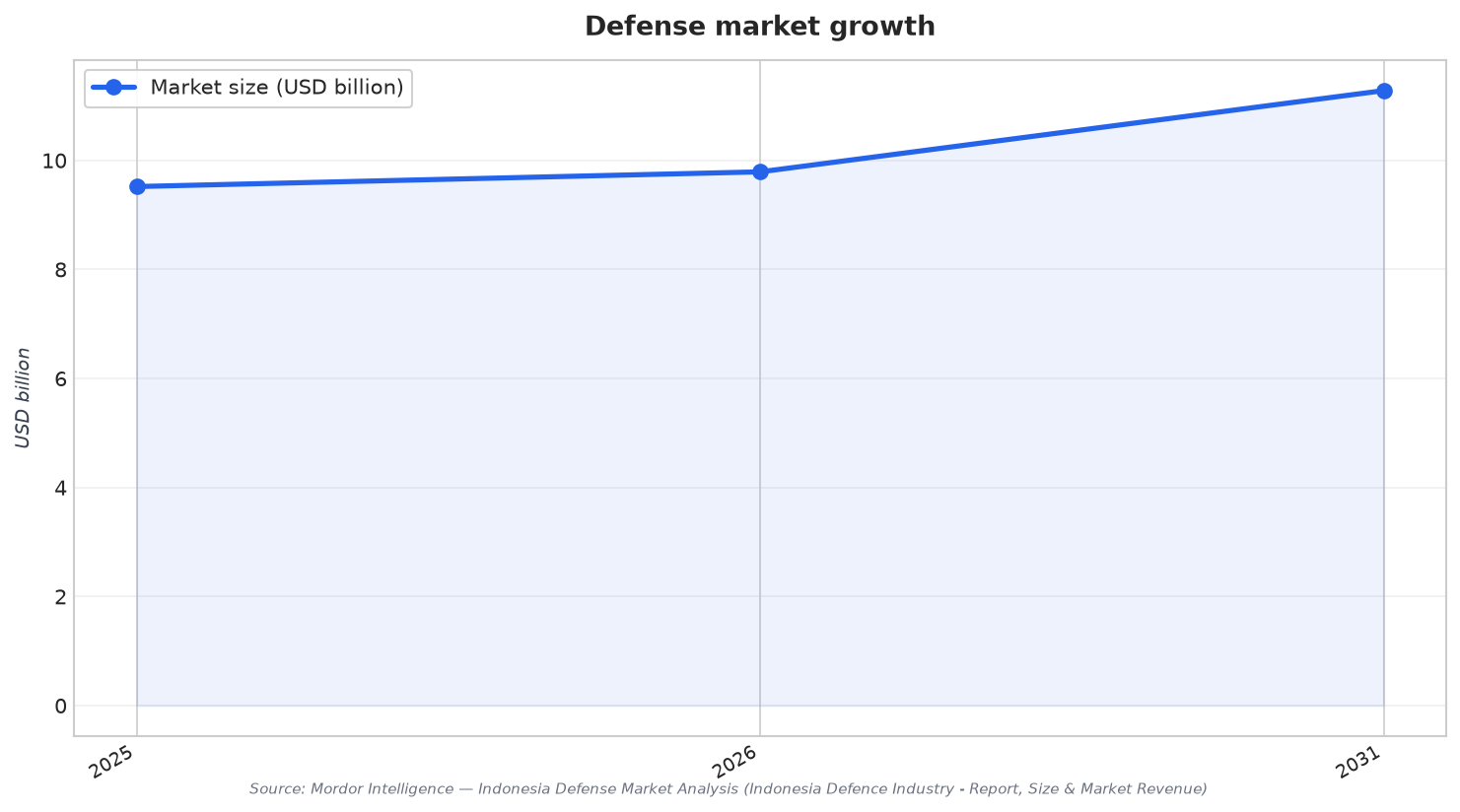
Indonesia’s modernization agenda is being reinforced by higher spending and a more explicit push for local participation. One market view valued the Indonesia defense market at USD 9.52 billion in 2025, with an estimate of USD 9.79 billion in 2026 and USD 11.28 billion by 2031. Another source describes Indonesia spending USD 15.0 billion on its military in 2025, a real increase of 28% from 2024. In parallel, Indonesia announced plans to invest USD 125 billion over the next three years to upgrade and modernize defense equipment, including nearly two-thirds (USD 79.1 billion) for new military equipment and USD 32.5 billion for contingencies and maintenance. These figures set the commercial backdrop for how policy levers like offsets, technology transfer, and domestic content are shaping deal structures.
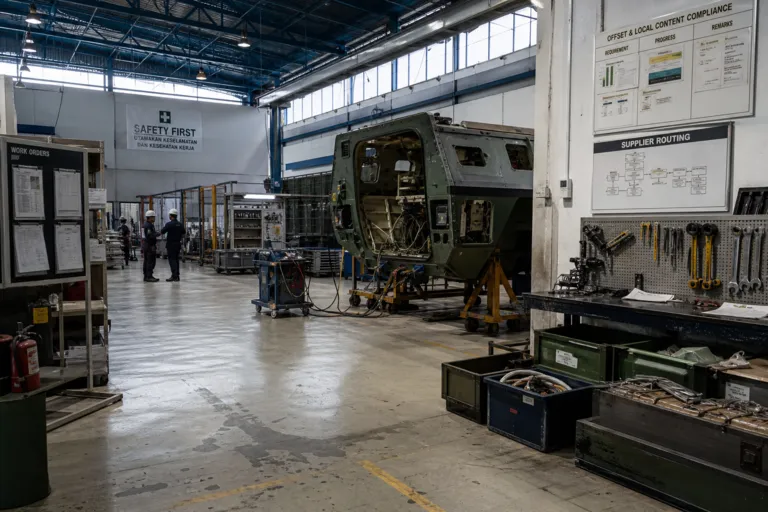
The center of gravity for industrial participation is increasingly defined by state-linked platforms and regional clusters. Industrial capability is described as concentrated around West Java and major state-owned defense facilities, particularly Bandung, with naval production in Surabaya. DEFEND ID, a consolidation of PT Len Industri, PT Pindad, PT Dirgantara Indonesia, PT PAL Indonesia, and PT Dahana, generated approximately USD 1.14 billion of arms revenue in 2024, which was 39% higher than the prior year. This matters because localization commitments are easier to execute when there is a scalable domestic prime-and-subcontractor ecosystem ready to absorb work packages such as local assembly, training, and sustainment. It also frames why foreign suppliers are often evaluated not only on platform performance, but on the credibility of their in-country teaming and delivery model.
Offset Pressure Meets Import Dependence
Indonesia’s procurement environment highlights a practical tension: offset and local-content expectations are rising, while many high-end subsystems still come from abroad. In unmanned defense vehicles, Indonesia is described as structurally import-dependent for complete UxV platforms and advanced mission payloads, with domestic content primarily limited to vehicle body fabrication, final assembly, and basic software integration. The same source estimates 70-80% import reliance on core subsystems. It also flags 12-18 month lead times tied to export controls (including ITAR and the Wassenaar Arrangement) for advanced autonomy software, sensor fusion modules, and secure communication systems. This is where Indonesia defense industry localization becomes less about replacing imports overnight and more about sequencing: localization of integration, testing, and MRO can progress even when certain controlled components remain foreign-supplied.
Policy-linked requirements are explicitly shaping niches like power systems as well. In fuel cells for aerospace and defense, one report notes that ITAR and national export controls on high-performance PEM and SOFC stacks, combined with Indonesia’s domestic-content requirements (TKDN) for defense procurement, create a dual challenge. Foreign suppliers are pushed to partner with local integrators, and local integrators must invest in MIL-SPEC certification infrastructure. The same report adds that domestic content obligations are pushing foreign stack manufacturers to establish local assembly and testing partnerships. For foreign OEMs, this points to a repeatable playbook: structure bids around local integration capacity, qualification pathways, and test-and-acceptance readiness, rather than treating offsets as a last-minute contractual add-on.
Large platform programs and sustainment needs reinforce the same direction of travel, while highlighting fiscal and execution constraints. Indonesia’s Minimum Essential Force (MEF) framework has supported programs that include plans to acquire 36 Dassault Rafale fighter jets and Boeing F-15EX Advanced Eagle multirole fighters, plus Airbus A330 Multi-Role Tanker Transport aircraft and Lockheed Martin C-130J Super Hercules transports. On the naval side, a cited USD 1 billion contract with DSME covers three Nagapasa Type 209/1400 diesel-electric submarines, alongside negotiations with France for four Scorpene submarines armed with Exocet SM39 missiles and two 2,500-ton Gowind corvettes. At the same time, The Jakarta Post notes foreign debt rose from an average of 7% of total defense revenue sources over 2019-2024 to about 25% in the past two years, and that import-heavy procurement can introduce currency risk. For suppliers, the openings are clear but specific: credible localization, lifecycle support, and financing-aware delivery plans that align with TKDN and offset expectations.
What is driving Indonesia’s recent defense spending push?
How concentrated is Indonesia’s defense industrial base?
How does Indonesia defense industry localization affect foreign suppliers?
What does the unmanned systems market say about import dependence?
What risks can affect procurement capacity and deal timelines?