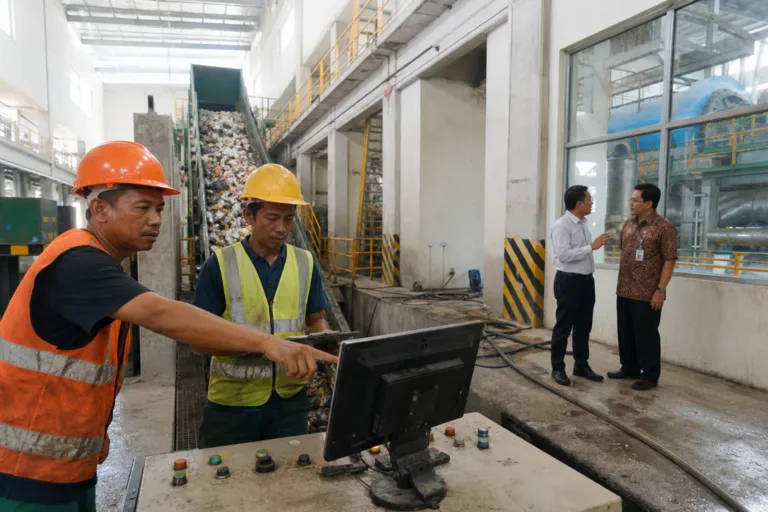
Indonesia’s urban waste challenge is now being framed as an infrastructure opportunity. A 2026 comparative analysis describes a municipal solid waste (MSW) crisis that generates over 91,324 tons daily in Indonesia, intensifying pressure on landfills and city services. Against that backdrop, market research positions waste-to-energy (WtE) and circular-economy activity as an investable segment: Ken Research values Indonesia’s waste-to-energy and circular economy market at approximately USD 1.7 billion. The same source highlights MSW as the most significant contributor because of its volume and energy conversion potential, making city-scale solutions central to what comes next.
Waste management fundamentals matter because WtE depends on steady inputs and reliable collection. Ken Research notes that in Indonesia’s waste management market, municipal solid waste holds a dominant share due to widespread urban generation and the need for robust collection and recycling mechanisms. By management type, collection has a dominant share, reinforced by investments in fleet and infrastructure and the expansion of collection networks. This is important for WtE planning because it links power-generation ambitions to day-to-day logistics: collection, segregation and sorting, recycling, and disposal (including landfill and incineration) are all part of the same value chain that feeds WtE facilities.
From Pilot Projects to a National Buildout
A key shift described by AKIGTP is a 2025 presidential regulation that anchors a “two-lane” framework. It is designed to address both urban landfill overflows and remote island logistics. The same source frames the approach as a move from isolated pilots to a national infrastructure buildout, and says the government is accelerating deployment of high-capacity WtE facilities for densely populated metropolitan areas running out of landfill space. This policy framing also connects WtE to circular-economy positioning in ASEAN, presenting Indonesia’s buildout as a potential blueprint for neighboring member states.
Technology and digital operations are also shaping how projects perform. NextMSC describes Indonesia’s waste management market as valued at USD 15.11 billion in 2023 and predicted to reach USD 31.15 billion by 2030, at a CAGR of 9.80% from 2024 to 2030. It highlights smart-city digitalization, including IoT tools such as sensor-enabled bins, GPS-tracked collection fleets, and centralized platforms for real-time monitoring, plus AI integration in sorting and recovery systems to automate material classification and improve recycling accuracy. These upgrades can improve feedstock quality and reduce operational friction for WtE facilities that depend on consistent waste streams.
Still, the infrastructure bet has social and environmental constraints that can define success or failure. The 2026 comparative study highlights socio-environmental frictions, including a systemic “lock-in effect” tied to reliance on combustible materials and an existential threat to Indonesia’s vast informal waste sector workforce. It concludes that sustainable deployment requires rigorous emission oversight, an inclusive transition for the informal economy, and uncompromising upstream waste segregation. Market participation is broadening as well: Ken Research lists major players active in the space, including PT PLN (Persero), PT Jakarta Propertindo (Jakpro), PT Veolia Services Indonesia, and Mitsubishi Heavy Industries Indonesia among others, reflecting how Indonesia waste-to-energy infrastructure is becoming a multi-stakeholder buildout rather than a single-operator model.
What is driving Indonesia’s push for waste-to-energy in cities?
How big is Indonesia’s waste-to-energy and circular economy market today?
How can smart-city tech improve WtE project performance?
What risks should planners consider for Indonesia waste-to-energy infrastructure?