Indonesia’s data center pipeline is expanding quickly, and the investment narrative is increasingly shaped by where new capacity can actually be powered and built. One forecast values the Indonesia data center market at USD 2.82 billion in 2025 and projects USD 6.09 billion by 2031, with a 13.71% CAGR. Another projects USD 2.81 billion in 2025 rising to USD 6.08 billion by 2031 at a 13.73% CAGR. These outlooks also highlight the main hubs: Jakarta and Batam are repeatedly positioned as focal points for hyperscale and colocation expansion, with Jakarta described as an epicenter hosting numerous advanced and hyperscale facilities.
Power is not a background variable in this cycle; it is a core gating factor for delivery timelines and site selection. In capacity terms, one outlook expects Indonesia’s IT load to grow from 1.44 thousand megawatt in 2025 to 3.56 thousand megawatt by 2030, a 19.89% CAGR. That trajectory frames the country’s rising Indonesia data center power demand, especially as hyperscalers and colocation providers pursue larger blocks of dependable electricity. The same outlook ties momentum to Jakarta’s dense fiber network and submarine cable landing points, while also pointing to long-term PLN power-purchase agreements as a mechanism that can unlock renewable megawatt blocks to support AI-ready configurations.
Why Jakarta and Batam Keep Winning—Even When Costs Rise
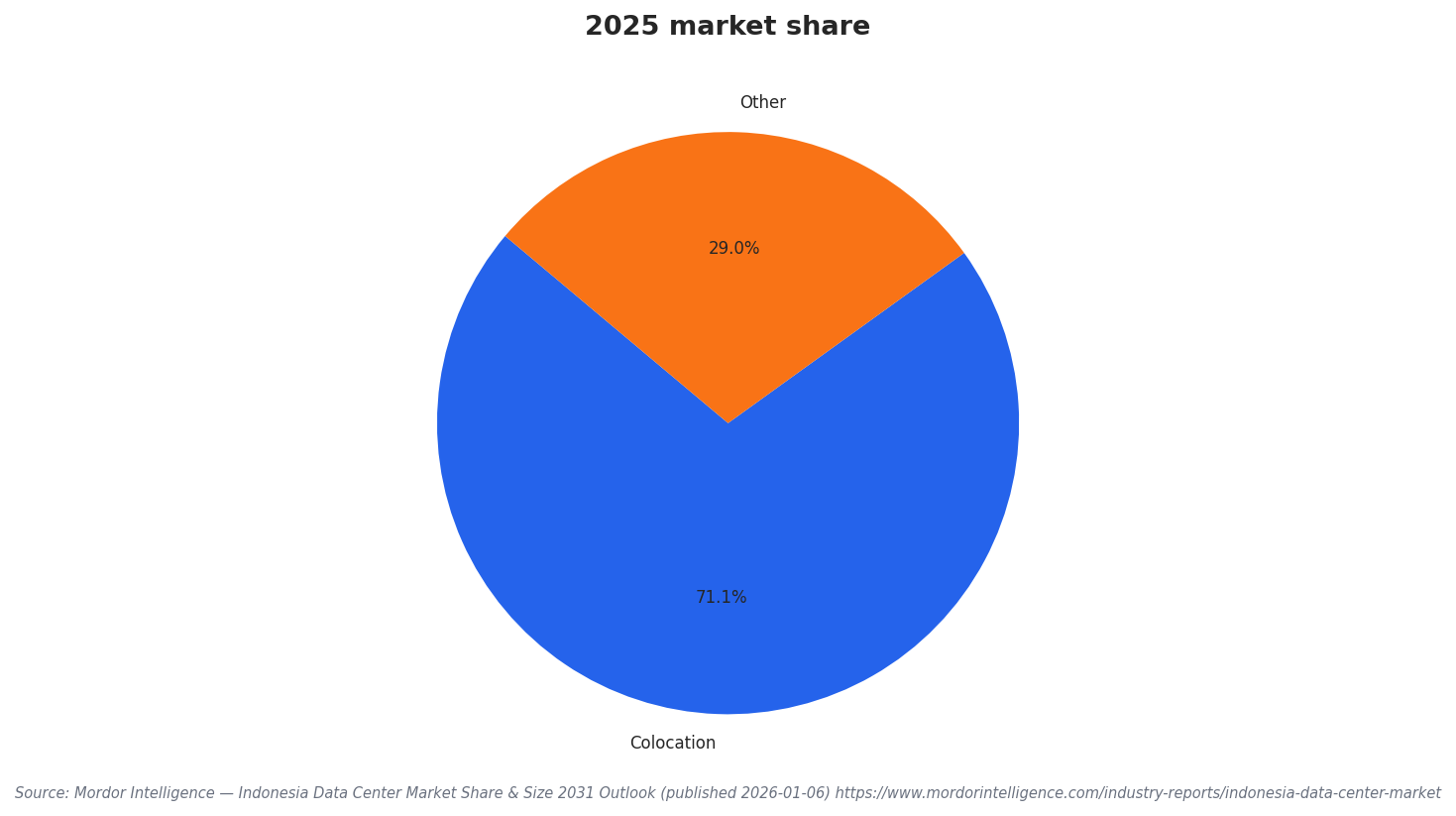
Jakarta’s lead is visible in market-share figures as well as network advantages. Jakarta held 56.72% of Indonesia’s data center market share in 2025, while Batam is forecast to expand at a 21.70% CAGR through 2031. Demand composition matters here: colocation accounted for 71.05% of market size in 2025, yet hyperscale deployments are advancing at a 20.95% CAGR to 2031. Batam’s positioning is also reinforced by specific cloud moves. In July 2025, Oracle announced its first cloud region in the country, the Indonesia North (Batam) cloud region with one availability zone, leasing a data center from DayOne in Nongsa Digital Park in Batam.
Land and buildability push cost decisions into the design and construction phase, especially around cable-linked sites and resilience requirements. In construction-focused research, cable landing stations are described as requiring seismic-resistant buildings, redundant 24 × 7 power, and secure meet-me rooms. Those requirements add 10–15% to base construction budgets, while strengthening the investment case for nearby data centers that can monetize connectivity. The same source describes a tradeoff when moving to secondary zones: it can require added capex for extra fibre laterals and longer power feeders. These choices often determine whether a site can scale efficiently as new capacity is added.
The market’s preferred facility profile also reflects a practical response to power and land realities. Tier 3 is presented as a dominant architecture in the operating market, with Tier 3 facilities capturing 83.90% of share in 2025 and forecast to grow at a 20.31% CAGR through 2031. A construction-market view similarly notes Tier 3 facilities at 51.3% of the Indonesia data center construction market size, describing a balanced cost-to-availability ratio. For investors, these figures align with a build strategy that targets concurrent maintainability without the premium of Tier 4, while still meeting enterprise expectations and supporting expansion in Jakarta and Batam as connectivity and power access shape what is feasible.
How fast is Indonesia’s data center market forecast to grow?
What do forecasts suggest about Indonesia’s data center power needs?
Which locations lead deployments in Indonesia?
How do cable landing requirements affect data center construction costs?
Why do Tier 3 designs dominate in Indonesia?