

Indonesia’s health insurance market is entering a tighter operating era as OJK’s POJK No. 36/2025 strengthens the “health insurance ecosystem” and raises the bar on governance and cost control. This shift lands in a system where BPJS Kesehatan’s JKN has near-universal reach, with 283 million participants representing 99.34% of the population by October 2025. That baseline coverage pushes private products toward supplementary value, including access to private hospital amenities and faster specialist visits under coordination of benefits. In parallel, medical cost pressure remains a core driver of regulatory attention: one report cites medical cost inflation at an estimated 13.6% in 2025, while employer retiree populations saw peer-reviewed medical inflation of 26.5% in 2022 and 20.48% in 2023.
POJK 36/2025 was issued in December 2025 and includes updated rules spanning copayment design, underwriting and repricing, waiting periods, coordination of benefits, and operational requirements such as digital integration with healthcare providers, data governance, and third-party administrator controls. Milliman notes insurers must sell health insurance products without co-payment features, while also describing limits that still apply to products that do include co-payment. Lockton adds that under the final regulation, co-payments are not mandatory, but insurers must offer at least one product without any co-payment. Where a copayment is applied, Lockton describes a cap of 5% of total claim cost for inpatient and outpatient services, with monetary limits of IDR 300,000 per outpatient claim and IDR 3,000,000 per inpatient claim, and an option for an annual deductible if clearly defined.
Compliance Playbook: Governance, Repricing Discipline, and Digital Readiness
The operational side of POJK 36/2025 is as consequential as product mechanics. Milliman lists requirements that include digital integration with healthcare providers, medical advisory functions, fraud detection systems, and public awareness programs on healthy lifestyles. Mordor Intelligence similarly frames the rulebook as mandating medical governance, utilization review, and digital capabilities across health insurers, with implementation tied to January 2026. Timing and transition expectations vary by source: Milliman describes a one-year implementation period from the issue date, while Reinsurance Business states insurers have until December 2026 to adapt existing products, and also reports a restriction that health product repricing can occur only once per year with at least 30 days’ written notice to policyholders.
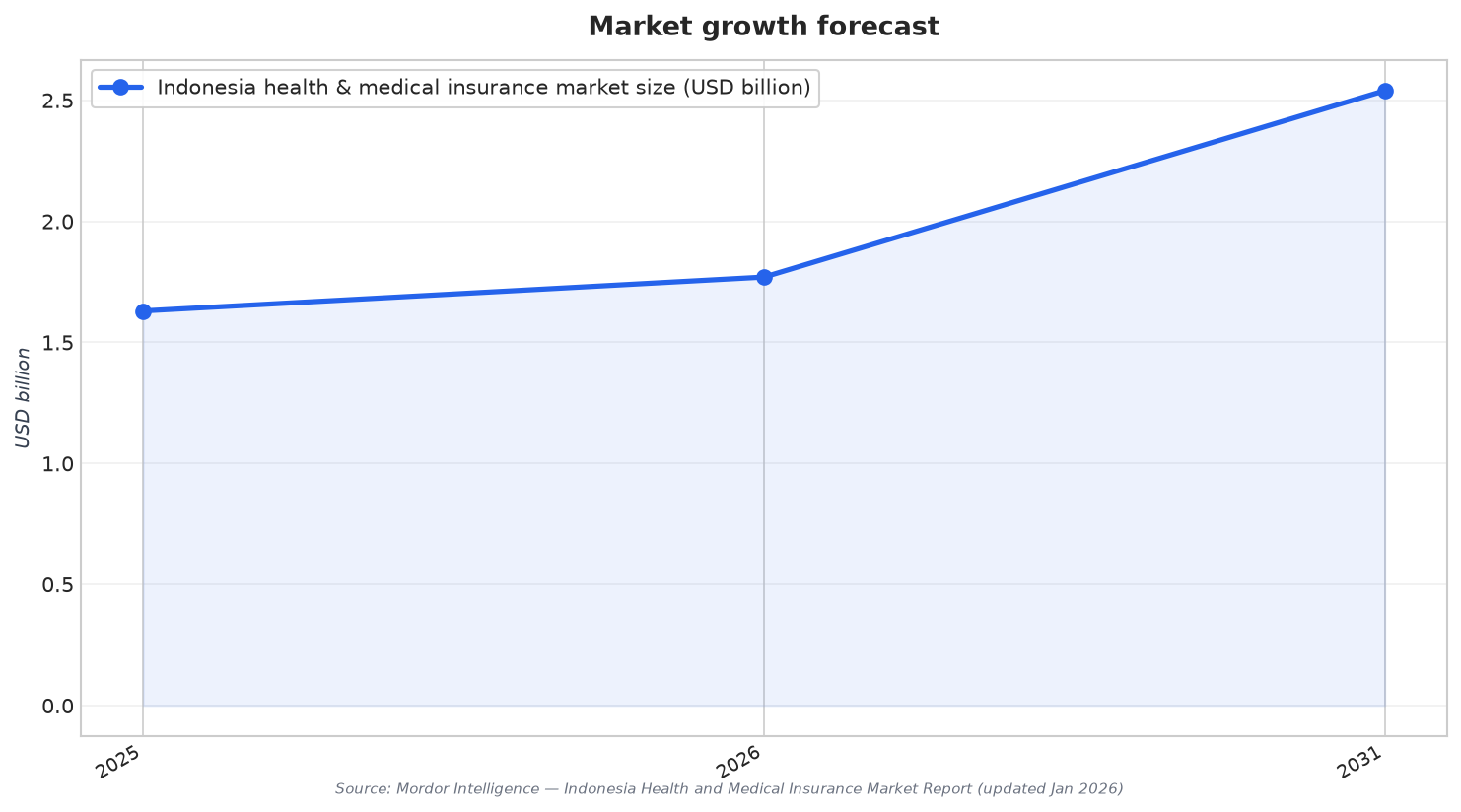
These requirements arrive as distribution modernizes and raises the compliance ceiling for both incumbents and digitally led challengers. Mordor Intelligence reports that Financial Service Aggregators licensed by OJK reached 20 registered providers with 1,172 institutional partnerships serving 13.10 million users in August 2025. Market structure signals why governance and digital execution may influence consolidation. Mordor Intelligence estimates Indonesia’s health and medical insurance market at USD 1.63 billion in 2025, growing from USD 1.77 billion in 2026 to USD 2.54 billion by 2031 at a 7.48% CAGR, while also noting no single player is dominant and that scale advantages accrue to strong bancassurance partnerships and advanced digital capabilities. A separate MarkWide Research forecast values the market at $8.7 billion in 2026, scaling to $22.99 billion by 2035 at an 11.40% CAGR, and discusses tiered consolidation linked to bancassurance networks, employer relationships, and digital platforms.
For stakeholders planning around the Indonesia health insurance regulation 2026, the governance narrative is not purely technical. A 2026 multi-stakeholder perception study on POJK 36/2025 reports that representatives from BPJS Kesehatan, AAJI, practitioners, providers, and academics viewed the regulation positively, and identified good governance, stakeholder collaboration, digital transformation, risk management, and improved insurance literacy and human resource competencies as key determinants for effective implementation. In practice, that points to a near-term workload: revising product terms, codifying medical and fraud controls, building reliable provider connectivity, and aligning repricing and communications processes. Over time, tighter standards can also change deal logic, as insurers and platforms that meet OJK expectations may find it easier to scale partnerships, distribution, and coordinated benefits designs.
What does POJK 36/2025 change for private health insurance products?
Are copayments mandatory under POJK 36/2025?
What governance capabilities does OJK expect insurers to have?
How does the Indonesia health insurance regulation 2026 affect repricing and policyholder communication?
Why is regulation tightening now, given BPJS Kesehatan’s large coverage base?