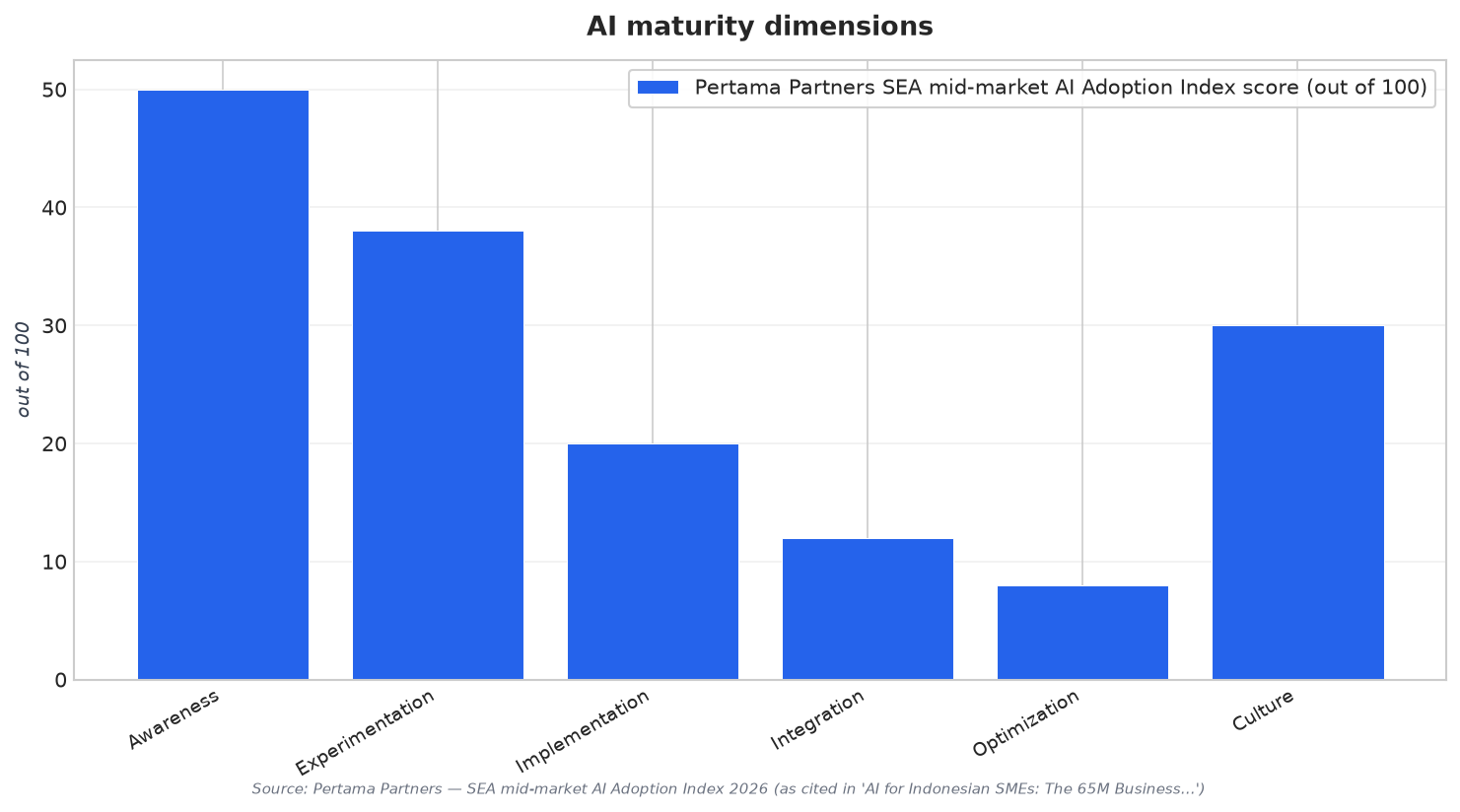
Indonesia’s AI maturity story is defined by scale, momentum, and gaps that shape how budgets get allocated. Pertama Partners describes the country as home to more than 65 million micro, small, and medium enterprises (MSMEs) that employ over 120 million people and account for roughly 60% of national GDP. Yet the same 2026 index says only 26% of Indonesian organizations have implemented AI tools, giving Indonesia a 27 out of 100 score and placing it in an “Early Experimentation” stage. The index also highlights a confidence-capability split: 93% of businesses say they are confident they can deploy AI, but implementation remains limited. In practice, that tension pushes corporate spending toward the basics needed to move from interest to execution.
AWS research frames the adoption curve as wide but shallow. It reports that 18 million, or 28%, of Indonesia’s businesses had adopted AI, with year-on-year growth of 47%, and that 5.9 million businesses adopted AI solutions in 2024. But most deployments still focus on near-term operational improvements: 76% of businesses remain centered on basic use cases like driving efficiencies and streamlining processes. Only 11% of AI-adopting businesses have reached an intermediate stage, and 10% are in a transformative stage where AI is core to product development and decision-making. That shape of adoption tends to direct spending into packaged tools and workflow changes first, before shifting into deeper data, model, and governance investments.
Where Corporate AI Spending Concentrates as Experimentation Accelerates
Signals of experimentation are strong, even if maturity is still emerging. Pertama Partners reports AI application revenue in Indonesia grew 127% year-on-year, the highest in Southeast Asia, while noting that integration barriers are widely cited and optimization remains early and trial-based. The same index reports that 45% of businesses have adequate digitally skilled talent, and that 37% of MSMEs are not yet using basic digital tools for daily operations—two constraints that naturally shape spend priorities. As pilots expand, budgets often flow into talent and enablement, plus the “plumbing” required for integration. Workato’s Indonesia-focused analysis also points to integration friction on legacy platforms and notes that demand for senior integration and DevOps engineers pushed salaries into double-digit growth in 2025, reinforcing why integration capability becomes a major cost center.
Infrastructure is another clear destination for enterprise spend, especially when workloads must run locally. Mordor Intelligence estimates the Indonesia Artificial Intelligence (AI) Optimised Data Center market reached USD 0.66 billion in 2025 and is forecast to climb to USD 1.44 billion by 2030, advancing at a 16.91% CAGR. In 2024, Cloud Service Providers led with 55.82% share, Tier 4 held 61.63% share, and software accounted for 45.83% share, while hardware is projected to grow at a 17.53% CAGR to 2030. Microsoft’s USD 1.7 billion pledge is cited as a driver that triggered vendor alliances and workforce programs. Together, these figures explain why corporate AI roadmaps often expand beyond software subscriptions into data-center capacity, resilient operations, and deployment environments designed for AI workloads.
The adoption curve also looks different by company type, shaping where spending goes. AWS reports 52% of startups in Indonesia are using AI in some way, and among those, 34% are building entirely new AI-driven products. Large enterprises lag on depth: 41% use AI, but only 22% have a comprehensive AI strategy, and only 21% deliver a new AI-driven product or service. Pertama Partners adds that among mid-market companies, 63% report having a clear AI strategy, compared with 80% of medium-sized organizations. This unevenness suggests near-term enterprise budgets will prioritize strategy, risk controls, and integration to avoid stalled initiatives—especially as Gartner figures cited by Workato indicate 40% of enterprise applications will be integrated with task-specific AI agents by end of 2026, up from under 5% in 2025, while more than 40% of agentic AI projects may be cancelled by end of 2027 due to inadequate risk controls and unclear business value.
What stage is Indonesia at on the enterprise AI adoption curve?
How widespread is AI adoption among businesses in Indonesia?
What do the sources say about basic versus advanced AI use cases in Indonesia?
Where does corporate spending go as Indonesia enterprise AI adoption moves beyond pilots?
How do startups and large enterprises differ in AI adoption depth in Indonesia?