Commercial due diligence in Indonesia should start with one clear aim: test whether the market story behind the deal is real. Commercial due diligence checks demand strength, competitive intensity, realistic growth capacity, customer pull, and pricing power. It also challenges whether forecasts reflect true market conditions by comparing them to evidence such as historical conversion rates and pipeline data. This work complements financial due diligence, because it goes deeper into the reasons behind the numbers, not only the accounting. As a global reference point, one source states the global commercial due diligence market was valued at USD 2.33 billion in 2025 and is expected to reach USD 5.01 billion by 2035, with a CAGR of 7.8%.
For buyers evaluating Indonesia, commercial findings become more valuable when you connect them to the country’s operating reality. Indonesia has a GDP exceeding USD 1 trillion in 2024, and it is forecast to become the world’s fourth-largest economy by 2050, which frames why deal flow attracts attention. But the same environment carries complexity. One legal due diligence guide highlights sector-specific licensing rules, foreign ownership restrictions, and a continuously evolving legal framework as risks for entrants who proceed without adequate preparation. A buyer’s commercial diligence should therefore include a practical “can this growth plan actually be executed here?” test, not only a market-size narrative.
A Buyer’s CDD Framework That Links Market Reality to Execution Risk
Use a structured sequence that moves from market truth to operational proof. First, validate the addressable market definition and segment logic, because inflated market sizing can weaken confidence in the plan. Next, stress-test competitive position by mapping direct competitors and substitutes, then verify differentiation through customer interviews and evidence of switching barriers and channel reach. Third, challenge forecast credibility with hard evidence and uncover risks hidden behind optimistic assumptions. Finally, link these conclusions to the target’s ability to operate legally and consistently. In Indonesia, that means checking whether the business is set up and allowed to operate, and whether it is listed correctly in the OSS and AHU systems, as highlighted in a local due diligence checklist.
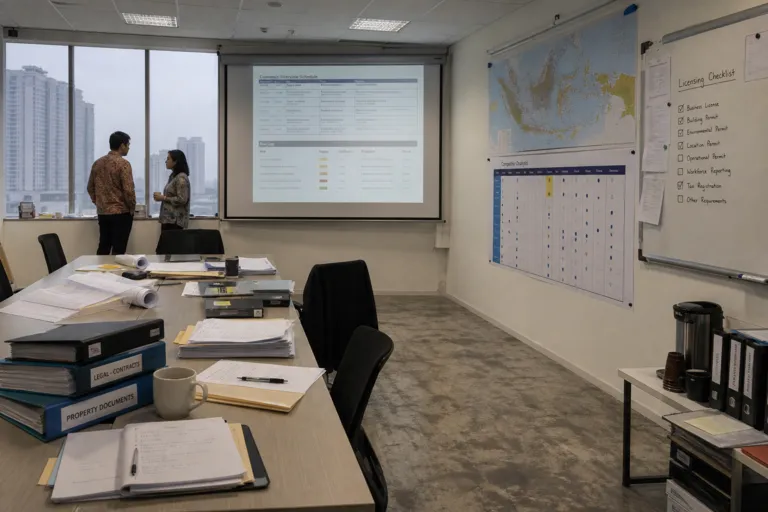
Execution risk in Indonesia is often rooted in licensing and ownership details, so buyers should treat them as commercial deal drivers, not mere legal footnotes. Indonesia operates a risk-based licensing system under Government Regulation No. 28 of 2025, which replaced the 2021 framework. Business activities are classified into four risk tiers—low, medium-low, medium-high, and high—with corresponding licensing requirements. A commercial diligence workstream should confirm whether the target’s licenses are valid, current, and correctly registered in the Online Single Submission system, because gaps can block go-to-market plans that looked sound on paper. It should also reflect foreign participation implications, since any foreign participation classifies a company as a PMA and triggers obligations under Investment Law No. 25 of 2007.
Close the loop by testing whether the target’s assets and contracts support the customer and growth thesis you validated earlier. Legal due diligence guidance in Indonesia emphasizes reviewing material contracts such as supplier contracts, customer agreements, joint venture arrangements, financing documents, and exclusivity arrangements to identify obligations that transfer with the business. If real estate or land is central to delivery, pair the commercial view with property verification steps described in Indonesia-focused guides: verify land certificates and ownership, check for encumbrances, liens, or disputes, and confirm zoning regulations and building permits. One property guide also advises verifying land title validity with the National Land Agency (BPN) and checking for overlapping claims. When these checks match your market findings, you have a buyer-ready view of value that truly goes beyond the financials in commercial due diligence Indonesia.
What is commercial due diligence in Indonesia meant to prove beyond the financial statements?
How can buyers pressure-test a target’s growth forecast during commercial diligence?
Which Indonesia-specific regulatory checks should be tied to the commercial thesis?
Why do property and land checks matter for a buyer’s commercial view?
What global benchmark figures are cited for commercial due diligence market growth?