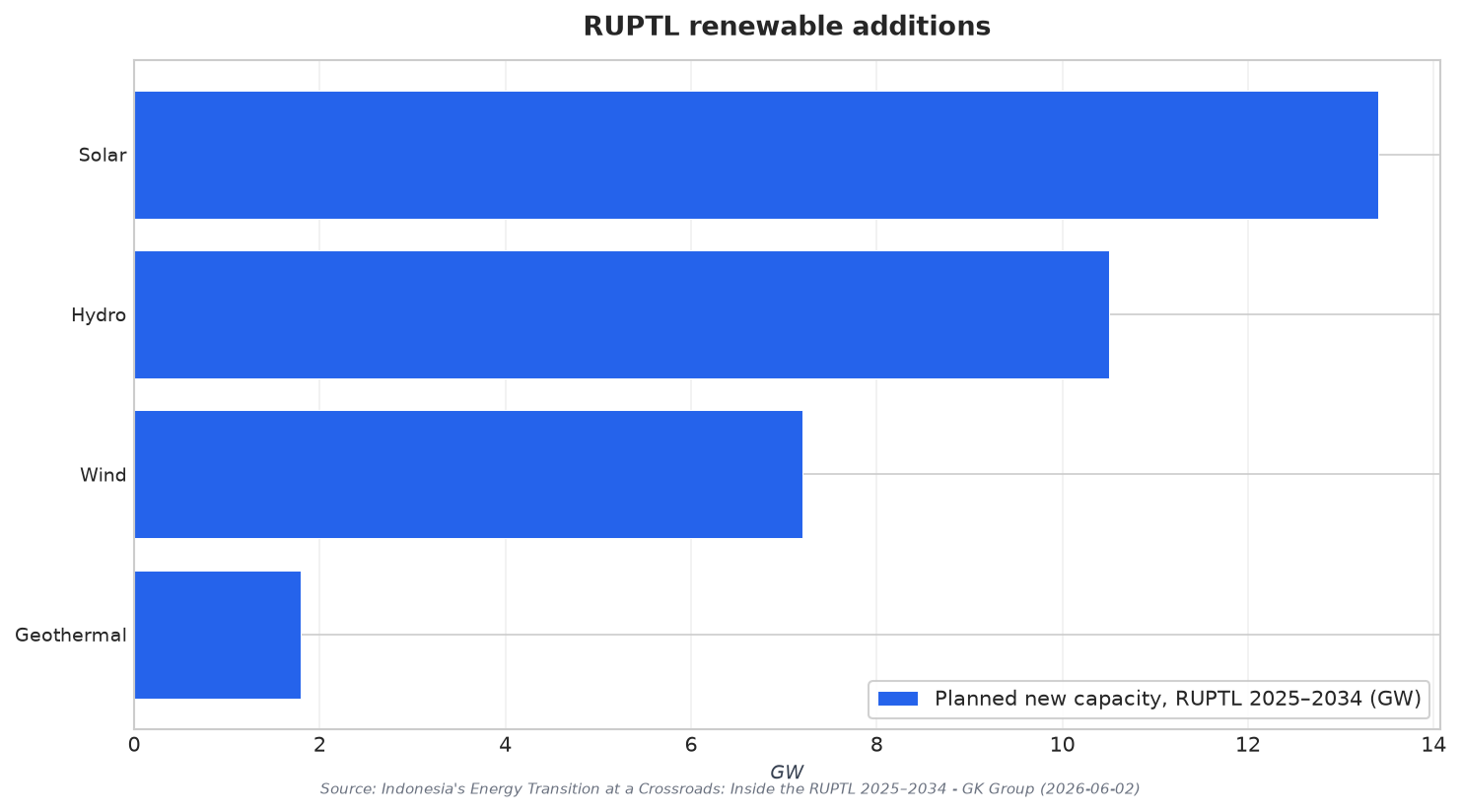
Indonesia’s power transition is increasingly defined by the gap between targets and delivery. As of December 2025, renewables supplied 15.75% of Indonesia’s electricity, while coal anchored roughly 68% of the power mix. The RUPTL 2025–2034 calls for 42.6 GW of new renewable capacity over the decade, including 1.8 GW of geothermal, alongside 10.3 GW of energy storage and major transmission upgrades. That plan leans on private-sector participation, especially independent power producers, and it arrives after a prior goal for renewables to reach 23% by 2025 was revised into a 19–23% range pushed out to 2030 under an updated National Energy Policy.
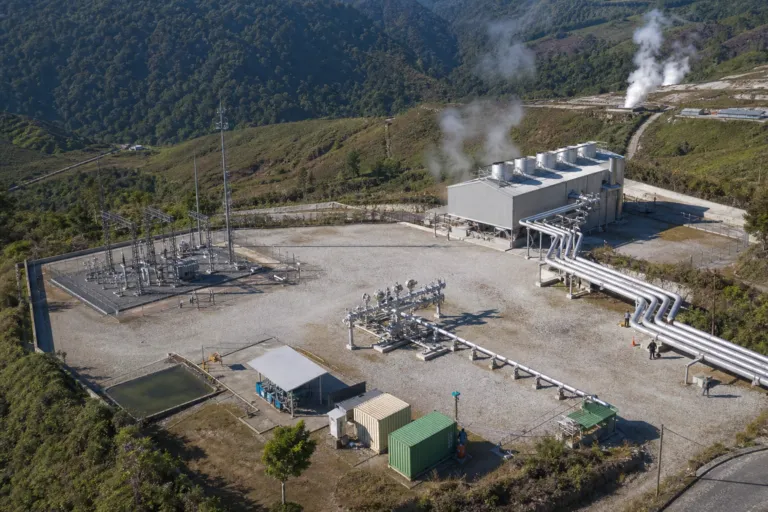
Geothermal fits the need for firm renewable generation, but it is also where Indonesia’s structural constraints show up. A SWOT-based case study of a 70 MW project in Dieng found that government support mechanisms received relatively low ratings, suggesting that existing policies may be insufficient to fully capitalize on opportunity. The study argues that clearer regulations and stronger financial incentives are required to attract sustained investment. It also scores threats to Indonesia’s geothermal sector at a total of 30, highlighting the weight of regulatory challenges and high upfront costs. These issues are not abstract: they shape how developers and lenders price risk long before a plant produces electricity.
Where the Money Is Moving—and Where It Isn’t
International and domestic capital is part of the solution, but funding is not evenly distributed across technologies. The JETP, unveiled at the 2022 G20 summit in Bali, committed US$20 billion, split between US$10 billion in public financing and US$10 billion in private money, to cap power-sector emissions at 290 million tonnes of CO₂-equivalent and lift renewables to at least 34% of generation by 2030. By December 2025, financing approvals reached roughly US$3.1 billion, funding projects including the Muara Laboh geothermal expansion and the Saguling floating solar plant. Yet the JETP Comprehensive Investment and Policy Plan shows a funding imbalance: a substantial share of the US$21.8bn transition package has flowed toward lower-risk solar, while geothermal continues to face financing bottlenecks tied to exploration risk.
That exploration risk is now being targeted more directly, which matters for Indonesia geothermal energy investment decisions. Newsbase highlights a new partnership between Star Energy Geothermal (Barito Renewables’ renewable arm) and US energy technology firm SLB to advance the Sekincau geothermal field in Lampung and put exploration assets in North Maluku in place. The emphasis is on reducing subsurface uncertainty through advanced mapping and reservoir analysis, and the market response was described as positive given SLB’s technical capability in mitigating exploration risk. Academic work also underscores the analytical gap: a 2025 techno-economic study notes that comprehensive analysis incorporating standardized software tools, risk analysis, and policy-linked financial mechanisms such as carbon pricing had not yet been undertaken for geothermal projects in Indonesia.
Policy design remains the other half of the bottleneck. Wikipedia’s overview notes that Indonesia’s geothermal plans rely largely on private investment, while investors cite technical (geological) risk, regulatory uncertainty, and pricing policies as concerns. It also references a mid-2011 regulation intended to guarantee that PLN would meet financial obligations to IPPs, but says it was criticized as too limited and failing to clarify key concerns, with prices another major issue. The same source cites Sarulla in North Sumatra, a 320 MW plant expected to cost around $1.65 billion, backed by lenders including the Asian Development Bank and the Japan Bank for International Cooperation, and notes the first 110 MW started in 2017. The direction is clear: better risk allocation, clearer rules, and workable pricing are central to scaling toward the government’s 5.3-GW geothermal target by 2034.
What does the RUPTL 2025–2034 target for geothermal additions?
How much financing has been approved under JETP as of December 2025?
Why is geothermal financing harder than solar in Indonesia’s transition plans?
What policy gaps most affect Indonesia geothermal energy investment?
What is Indonesia’s geothermal capacity target by 2034 mentioned in recent reporting?