Indonesia’s enterprise AI story is defined by scale, momentum, and a stubborn execution gap. The country is Southeast Asia’s largest economy and has more than 65 million MSMEs that employ over 120 million people and account for roughly 60% of national GDP. Its digital economy is projected to exceed USD 130 billion by 2026. Yet the Pertama Partners SEA mid-market AI Adoption Index 2026 says only 26% of Indonesian organizations have implemented AI tools, and Indonesia scores 27 out of 100, in the “Early Experimentation” stage. That score is below the regional average of 31 and below Singapore’s 52, which frames the opportunity as well as the challenge.
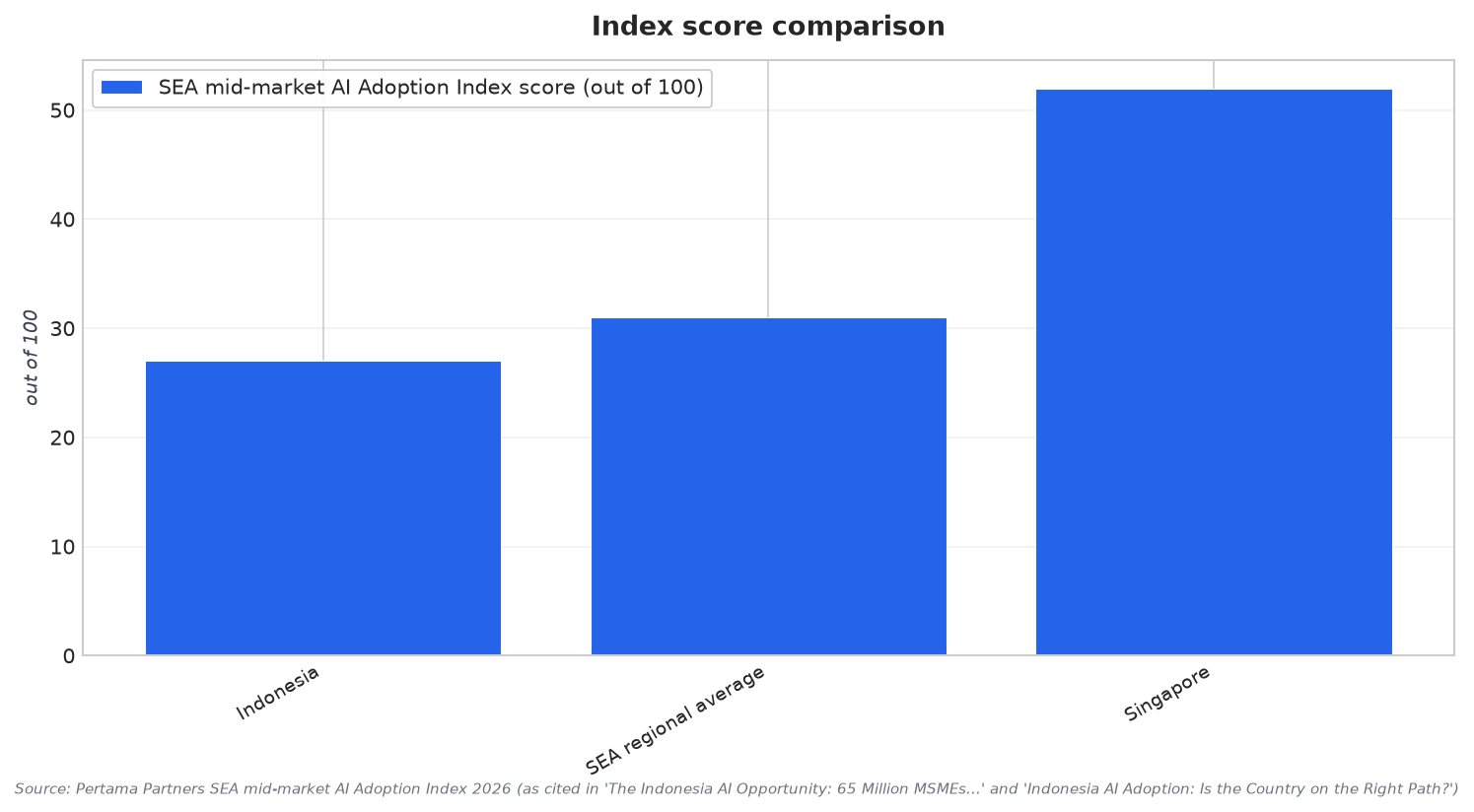
Under the hood, the index breaks the maturity problem into clear components. Awareness is 50/100 and experimentation is 38/100, but implementation is 20/100, integration is 12/100, and optimization is 8/100. At the same time, 93% of Indonesian businesses express confidence in their ability to deploy AI, while just 45% have adequate digitally skilled talent. There is also a wider digital foundation gap, since 37% of MSMEs are not yet using basic digital tools for daily operations. Indonesia enterprise AI adoption, in other words, is not mainly blocked by belief. It is blocked by readiness, skills, and the ability to connect AI to day-to-day systems.
Where Corporates Are Investing: Cloud, Centers, and Integration
Corporate and national investment signals are strong, and they cluster around infrastructure and enablement. Indonesia published its AI National Roadmap White Paper in July 2025. Microsoft committed USD 1.7 billion to cloud and AI infrastructure in-country, described as the company’s largest investment in Indonesia’s history. NVIDIA and Cisco also co-funded an AI Centre of Excellence with Indosat, targeting AI access for hundreds of millions of Indonesians by 2027. On the broader digital transformation track, spending is forecast to reach USD 29 billion in 2026 and grow to USD 69.57 billion by 2031. The bet is clear: build capacity now so enterprises can move beyond pilots later.
But ROI depends on whether AI can act inside real workflows, not just generate outputs. Workato argues that most Indonesian organisations are still running integration infrastructure designed for a different era, making it hard for AI agents to reliably pull data from ERP systems, update CRM records, or route decisions with governance. In regulated environments, the constraints are sharper. Indonesia’s Personal Data Protection Law came into full effect in 2024, and OJK digital banking mandates require clear audit trails and data governance across integrated systems. A brittle, centralized legacy ESB-style approach can make compliance harder, not easier, when AI is layered on top. This is why integration modernization is positioned as a prerequisite to enterprise-grade AI value.
The ROI reality is also shaped by measurement discipline and by the gap between deployment and value capture. A global statistic cited by AI Business Weekly reports 56% of CEOs say they have zero measurable ROI despite deployment (PwC, January 2026), and it adds that only about a third of organizations have scaled AI beyond pilots. A16z provides another global benchmark: 29% of the Fortune 500 and about 19% of the Global 2000 are live, paying customers of a leading AI startup, and it calls support a function where ROI is clearest because outcomes are measurable. For Indonesia, the key takeaway is practical: separate adoption from maturity, and measure value across business, operational, risk, and adoption outcomes, not with a single headline ROI number.
What do the latest benchmarks say about enterprise AI adoption in Indonesia?
Where are Indonesian corporates and partners investing to enable AI?
Why do many AI programs struggle to show ROI even after deployment?
What is the biggest technical constraint on turning AI into enterprise outcomes in Indonesia?