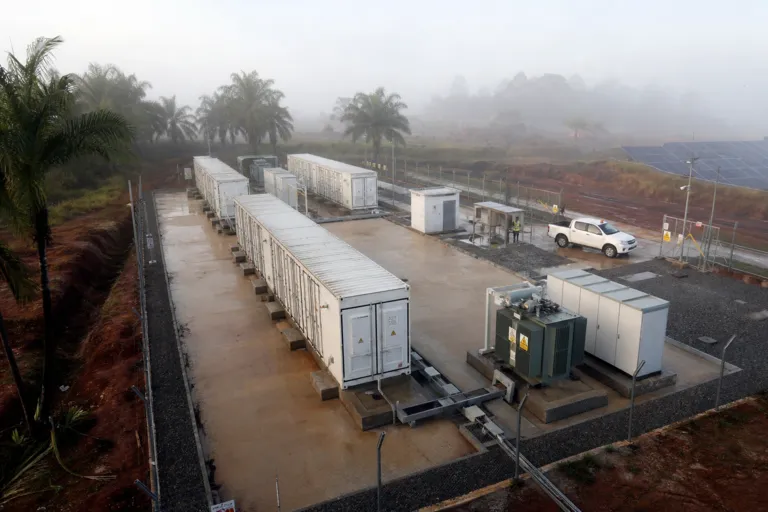
Indonesia’s storage story is shifting from a handful of early deployments to a more structured pipeline backed by utility execution, regulation, and falling technology costs. IndexBox estimates Indonesia’s total installed advanced battery capacity at approximately 0.3–0.5 GWh as of early 2026. In parallel, IndexBox describes the advanced energy storage systems (AESS) market as still nascent, with roughly 200–300 MW installed as of 2026 and dominated by a small number of utility-scale projects on Java and Sumatra. This is the context for the Indonesia battery energy storage market: the base is small, but the project logic is becoming clearer as procurement starts to standardize around solar-plus-storage, microgrids, and front-of-the-meter grid support.
The most concrete pipeline signal comes from PLN. Mordor Intelligence reports that in April 2026, PT PLN (Persero) confirmed execution of 21 solar-plus-BESS projects across seven provinces, combining 513 MWp of solar capacity and 9.03 GWh of storage, with COD targeted from 2026 to 2028. The same program is linked to replacing 741 diesel power units, which connects batteries directly to operational goals beyond renewable integration. IndexBox also notes that hybrid solar-plus-storage is becoming the preferred procurement model for IPPs, with at least 2–3 GW of solar PV in the pipeline that will require co-located storage to meet grid interconnection requirements. Together, these points show why the pipeline is increasingly anchored in repeatable project templates.
What Is Accelerating Demand: Mandates, Costs, and Island Use-Cases
Regulation is now creating a demand floor. IndexBox states that MEMR issued Ministerial Regulation No. 11/2023 mandating battery storage for new solar PV plants above 1 MW, a requirement that could add 0.5–1.0 GWh of annual procurement by 2028. Economics are also tightening procurement decisions. IndexBox puts all-in installed grid-scale system prices in Indonesia at USD 350–550/kWh, with cells contributing roughly 50–60% of total cost. It also notes that cell-to-pack and cell-to-chassis designs entering via Chinese system integrators can reduce pack-level costs by an estimated 10–15% versus conventional module-based designs. For remote and island grids, IndexBox highlights long-duration storage interest (4–8 hours), especially where diesel displacement competes against diesel generation at USD 0.20–0.35/kWh.
Market structure still reflects heavy import dependence even as integration value grows locally. IndexBox describes the AESS market as import-dependent for core components such as battery cells, power conversion systems (PCS), and battery management systems (BMS), while local value concentrates in system integration, balance-of-plant engineering, and deployment. Pricing is affected by Indonesia’s import duty structure of 5–10% for HS 850760 and HS 850440, with potential exemptions for renewable energy projects, plus local content requirements (TKDN) of 30–40% domestic value for government-funded projects. On chemistry, IndexBox estimates LFP accounts for 65–75% of utility-scale project commitments in 2025–2026, driven by safety profile, cycle life, and reduced cobalt exposure. These constraints and preferences influence which vendors can scale and how quickly projects can be delivered.
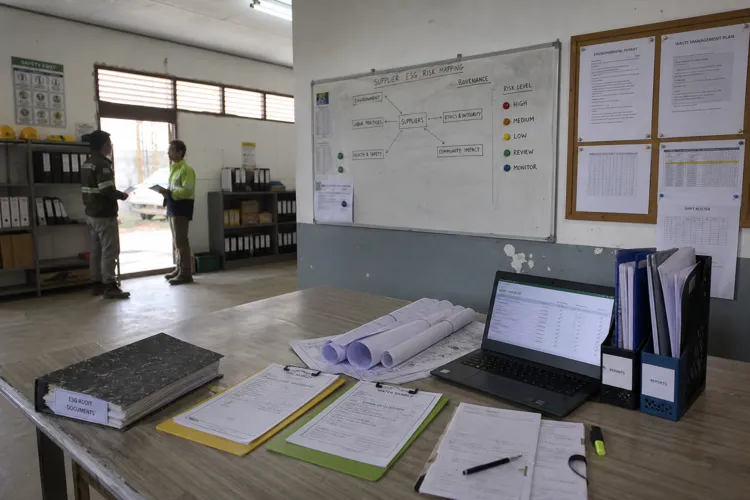
Industrial policy and supply chain governance are becoming part of the project narrative. IndexBox notes that Indonesia has the world’s largest domestic nickel processing capacity, yet local cell manufacturing remains nascent with fewer than 1 GWh of domestic cell production capacity operational in 2026. Other sources point to planned manufacturing scale: Ken Research projects expected lithium-ion production capacity in Indonesia reaching 10 GWh, while Mordor Intelligence reports a February 2026 PLN framework agreement with IBC, ANTAM, and the HYD Investment Limited Consortium for a USD 6 billion integrated battery manufacturing project targeting up to 20 GWh of annual production capacity. Separately, IndexBox’s traceability report expects mandatory traceability requirements and battery passport frameworks to be phased in between 2026 and 2028, with compliance-driven demand potentially accounting for 40–50% of traceability market value by 2030. For project developers, these shifts increasingly shape procurement, reporting, and partner selection.
What is the installed base of advanced batteries in Indonesia as of early 2026?
What large confirmed pipeline is PLN executing for solar-plus-storage?
How is regulation shaping demand for storage alongside solar in Indonesia?
What are typical installed price ranges for grid-scale BESS in Indonesia?
What is changing in the Indonesia battery energy storage market supply chain and governance?