
Indonesia’s housing market is being reshaped by tax support that lowers the effective cost of buying certain homes. Cushman & Wakefield notes that the current regulation extends a 100% VAT subsidy for residential properties until 2026, and the government has signaled plans to continue it through December 2027. The coverage is explicit: landed houses priced up to IDR 5 billion, with a subsidy cap of IDR 2 billion. This structure matters for demand. It creates a clear “qualifying band” that can pull buyers toward units that fit the threshold, while encouraging developers to position new supply and marketing around the same ceiling.
That incentive design lands in a market where households are still the main demand engine. Mordor Intelligence reports residential real estate led Indonesia’s overall real estate market with 55.1% share in 2025. Individuals and households accounted for 73.7% of the market share that year, and the sales channel represented 72.2%. In other words, the sector is still driven by end-user purchasing more than leasing. Against that backdrop, an Indonesia property VAT incentive does more than reduce a tax line item. It can deepen buyer pools, as Mordor Intelligence also notes that residential sales stay supported by VAT waivers and mortgage incentives that broaden demand.
How VAT Relief Is Redirecting Demand to Price-Qualified Homes
Multiple sources point to the same pattern: relief tied to a maximum price encourages developers to design and price products to qualify. Mordor Intelligence highlights sub-USD 67,000 two-bedroom apartments that qualify for VAT exemptions, and links this to stabilizing primary residential sales as shown by Bank Indonesia’s Q3 2025 data. The ecommercenet summary similarly flags VAT relief on homes up to IDR 5 billion and frames it as part of affordability support. When buyers are comparing options closely, that eligibility boundary can become a deciding feature, shaping everything from unit size and finishing packages to how developers position projects in urban cores and commuter areas.
The incentive effect is occurring while transaction behavior remains cautious. Bamboo Routes estimates that as of 2026, a normal residential property in Indonesia usually needs about 90 to 120 days to sell. It adds that well-priced landed houses in strong urban areas often fall into about 60 to 90 days, while apartments, luxury villas, and overpriced homes can take about 100 to 160 days. The same source estimates most residential properties sell about 3% to 8% below asking price, with only around 5% to 10% selling above asking. In that environment, VAT support can operate as a practical lever: it does not eliminate negotiation, but it can influence which listings attract the broadest set of qualified buyers.
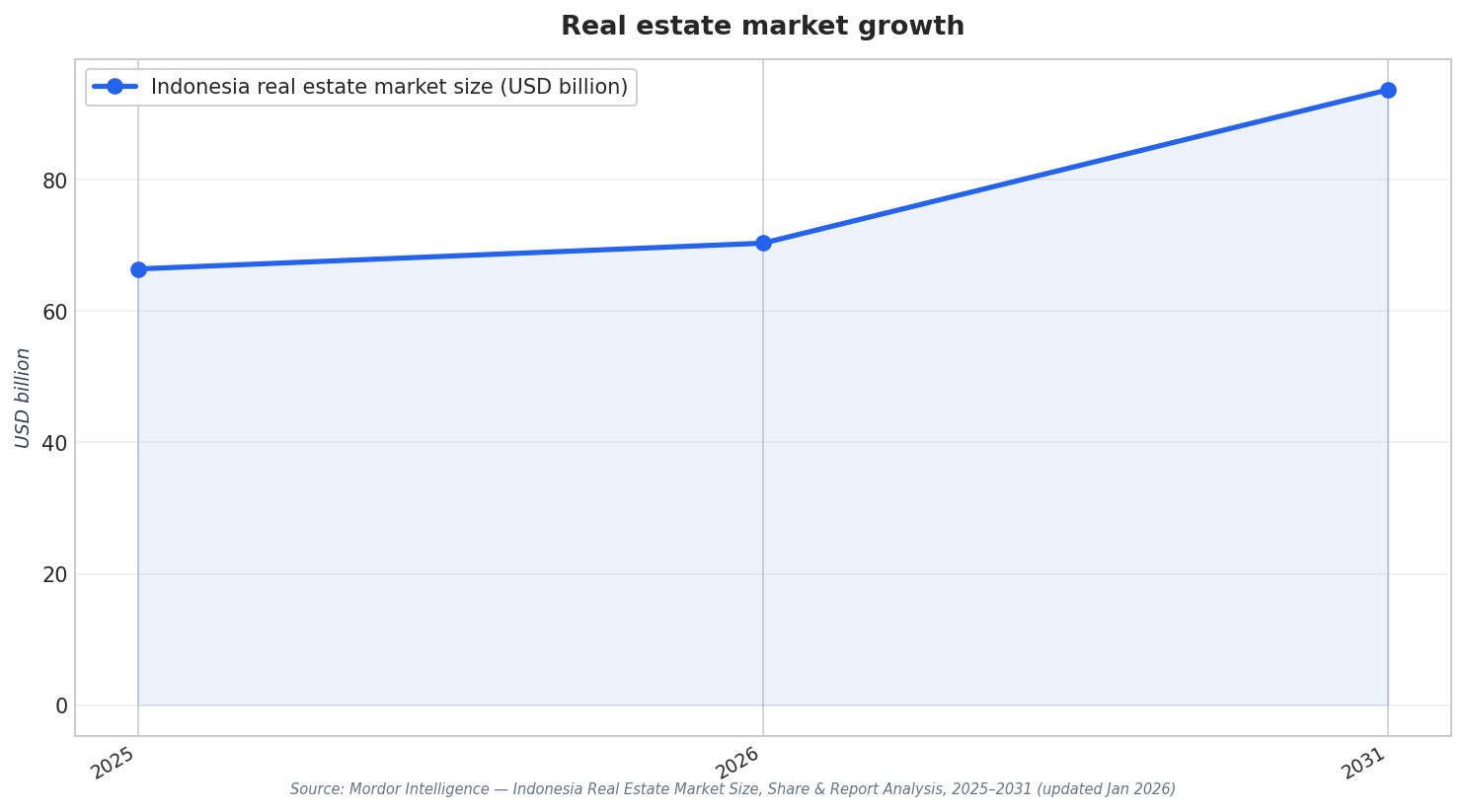
Over time, the incentive-driven tilt toward qualifying inventory can ripple into the wider market’s geography and product mix. Mordor Intelligence projects Indonesia’s total real estate market expands from USD 66.44 billion in 2025 and USD 70.37 billion in 2026 to USD 93.75 billion by 2031, a 5.91% CAGR from 2026 to 2031. It also notes capital shifting from Jakarta to second-tier hubs in West and East Java, while DKI Jakarta held 39.4% revenue share in 2025 and East Java is forecast to grow at a 7.11% CAGR through 2031. If VAT-linked demand keeps concentrating under IDR 5 billion, developers may keep tuning supply to that band across these growth corridors, especially where land and construction choices can support price discipline.
What does Indonesia’s VAT subsidy cover for housing purchases?
How is the Indonesia property VAT incentive changing what buyers look for?
Are Indonesian homes selling quickly in 2026?
How much negotiating is happening in Indonesia’s residential market?
How important are households to Indonesia’s real estate demand?