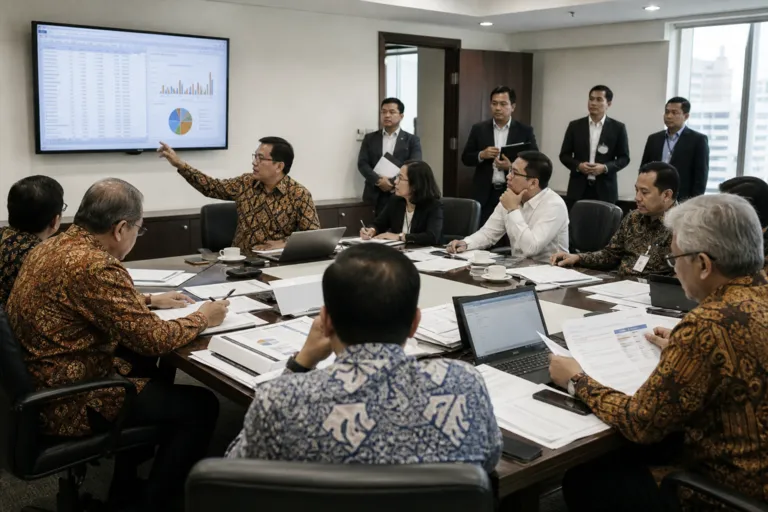
Indonesia’s path toward OECD accession is being described as a major reform journey, with implications that go beyond external branding. In April 2026 remarks reported by ANTARA News, OECD Secretary-General Mathias Cormann said the process can help Indonesia build a more competitive business environment through regulatory improvement, stronger market competition, and enhanced public integrity. The same remarks outline the mechanics of scrutiny: a comprehensive review by 25 OECD technical committees across policy areas from trade and investment to innovation, public governance, and education. For companies, that breadth matters because it suggests reforms will touch real operating conditions, including compliance, licensing, and competitive neutrality across sectors.
Research focused on the accession process stresses that outcomes depend on the state’s ability to deliver implementation, not just adopt new rules. A 2026 institutional analysis in the International Journal Administration, Business & Organization argues that OECD accession offers a structured pathway for regulatory harmonization, but success is contingent on institutional capacity, inter-agency coordination, and policy sequencing. The study warns that weak administrative capacity can lead to “formal compliance” without effective implementation. For business confidence, this distinction is critical: the credibility gains from accession depend on whether reforms translate into predictable enforcement, monitoring systems, and coordination mechanisms across ministries and regulators.
What Reforms Businesses Should Watch During the Technical Review
OECD analysis of Indonesia’s reform priorities highlights several practical bottlenecks and recent changes that businesses can map to costs and growth constraints. In its 2026 “Foundations for Growth and Competitiveness” coverage of Indonesia, the OECD notes that adoption of digital tools by the broader business sector has been modest, that digital firms with intangible assets have difficulty accessing finance, and that shortfalls in digital skills are widespread across the population, including among students, teachers, and government employees. It also describes persistent infrastructure bottlenecks, especially outside Java, citing gaps in electricity reliability, road connectivity, port capacity, and urban transport that reduce logistics efficiency, inflate costs, and limit access to markets and services. The same source points to reforms in recent years, including streamlined business licensing and labour market frameworks, gradual liberalisation of foreign direct investment across sectors such as energy, telecommunications, and e-commerce, and a tax reform that reduced corporate tax rates, expanded VAT coverage, and included provisions for carbon taxation.
Economic modeling from the Center for Indonesian Policy Studies (CIPS) frames accession as a catalyst for investment and output gains under an accession scenario compared with a baseline without accession. One CIPS analysis projects a potential surge in foreign investment of up to USD 87.7 billion by 2028 and estimates GDP growth could be lifted by nearly 1 percentage point annually under the modeled scenario. A separate CIPS publication provides a time-profile for investment relative to baseline: projected to be 1.2 percentage points higher in the short term (2028–2030) and 1.8 percentage points higher in the medium term (2031–2035), before a long-term projection (2036–2045) of the investment growth rate being 0.38 percentage points lower than baseline as the economy stabilises after the initial boost. For investors, these projections are less about a single number and more about the implied reform sequence and confidence effects that come from aligning governance, economic policy, and trade standards with international best practices.
At the sector level, the CIPS materials emphasize that reforms tied to accession can change market access and competitiveness through policy choices. The report highlights opportunities in manufacturing, services, extractives, and green energy, and it links competitiveness to reviewing non-tariff measures, liberalizing services, and removing Local Content Requirements. It also argues Indonesia must conduct a comprehensive gap analysis against OECD legal instruments and implement reforms to align policies. For businesses planning medium-term investments, the practical signal from the Indonesia OECD membership agenda is that policy change is likely to arrive through structured reviews, committee-by-committee expectations, and cross-cutting governance upgrades that can either strengthen predictability or, if capacity is weak, create a gap between new rules and on-the-ground implementation.
What does Indonesia’s OECD accession process involve in practice?
How could OECD accession affect investment expectations?
What is the biggest implementation risk highlighted by researchers?
Which reform areas does the OECD highlight as priorities for competitiveness in Indonesia?
How might Indonesia OECD membership shape business confidence?