Indonesia and the United States signed a trade pact on 19 February that includes Jakarta agreeing to purchase around $33 billion worth of U.S. energy, agriculture, and aerospace products. ICIS reported that, within this package, Indonesia will purchase about $15 billion worth of U.S. energy commodities. While the headline frames a large commitment, the sources also stress that breakdowns by value were not disclosed for the broader set of memorandums of understanding (MoUs) across sectors. Still, the explicit energy figure signals a meaningful import channel tied directly to the new bilateral framework, and it sets expectations for how near-term commercial flows could be structured.
The trade pact also fixes the tariff environment that surrounds these purchases. Asia Financial reported that the accord sets a 19% tariff on Indonesian goods entering the United States, and that Indonesia had faced the prospect of a 32% levy prior to the agreement. The same report cited a White House fact sheet saying Indonesia agreed to exempt U.S. companies from local content requirements and to address and prevent barriers to U.S. agricultural products sold in Indonesia. In practical terms, the “Indonesia US energy import deal” narrative sits inside a wider bargain that mixes market-access conditions and procurement commitments with a clarified tariff rate on Indonesian exports to the U.S.
Energy Commitments: Imports and Recovery Projects Move Together
Energy is not only a purchase commitment; it also shows up as operational cooperation. Reuters and Investment Monitor both described 11 deals valued at $38.4 billion signed at a dinner hosted by the U.S. Chamber of Commerce, covering sectors including mining and energy. Among the agreements, Investment Monitor reported an arrangement between Pertamina and Halliburton to collaborate on oilfield recovery projects. That matters because it suggests a two-track energy approach: buying U.S. energy commodities (ICIS put that at about $15 billion) while also pursuing projects intended to improve oilfield recovery. Taken together, imports and services partnerships can reinforce each other by pairing supply with efforts that affect production performance.
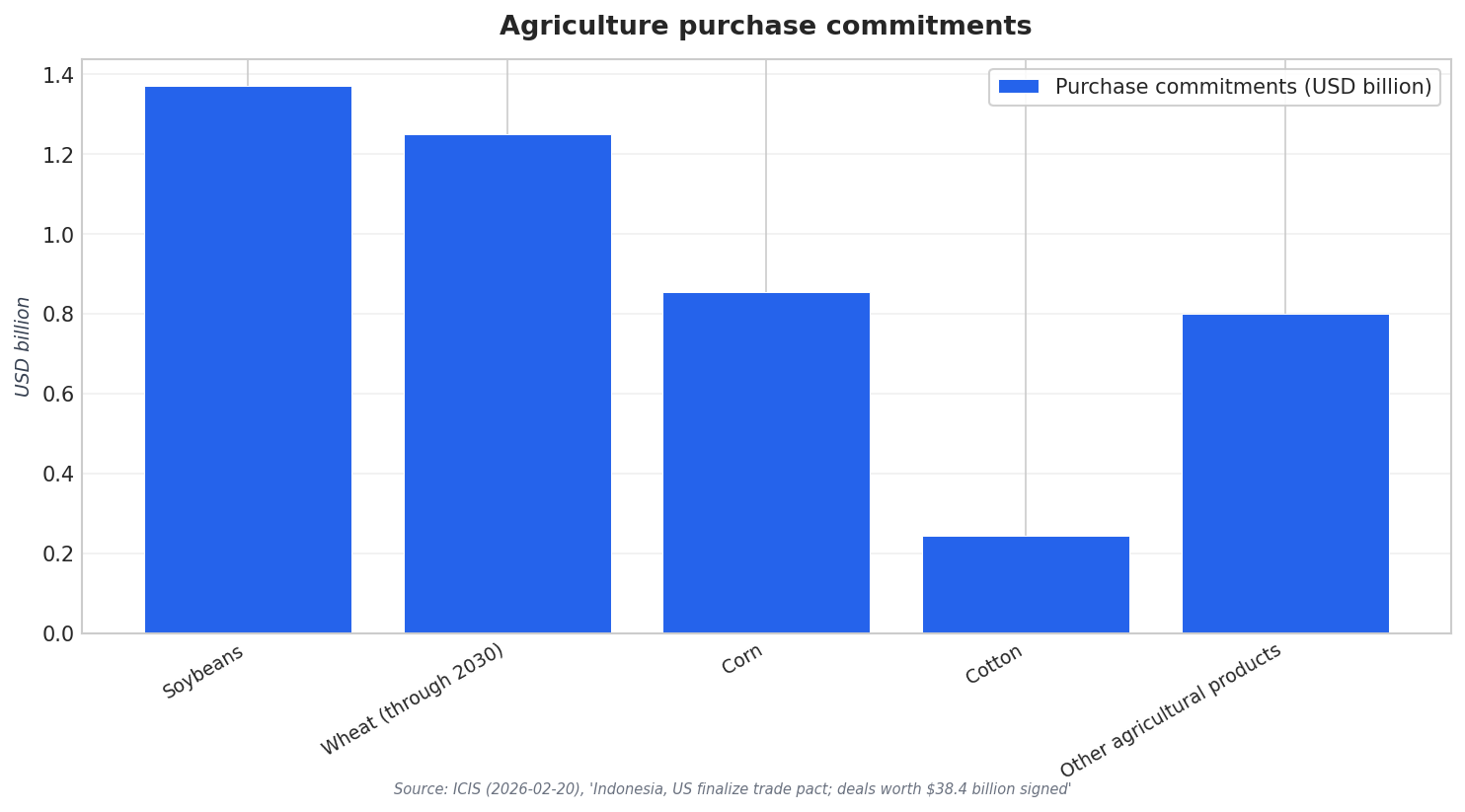
Agriculture figures in the pact help explain how the package is constructed and why energy is only one component of a broader sourcing plan. ICIS stated Indonesia will buy more than $4.5 billion worth of U.S. agricultural products, including soybeans ($1.37 billion), wheat ($1.25 billion) until 2030, corn ($855 million), cotton ($244 million), and other unspecified products ($800 million). ANTARA echoed the same $4.5 billion total and line items. Investment Monitor added that the US-ASEAN Business Council stated Indonesia will purchase one million metric tonnes of wheat in 2026, with up to five million tonnes expected by 2030, and noted trade data showing Indonesia imported an annual average of 2.3 million metric tonnes of U.S. soybeans from 2015 to 2024, plus nearly 800,000 tonnes of wheat, about 180,000 tonnes of cotton, and under 100,000 tonnes of corn per year.
For aviation, Asia Financial reported Indonesia agreed to purchase $33 billion worth of U.S. energy commodities, agricultural products, and aviation-related goods, including Boeing aircraft. ICIS similarly included aerospace products in the around-$33-billion purchase description, but deal-by-deal values were not disclosed. This structure implies that aviation procurement is being advanced alongside energy imports, rather than treated as a separate negotiation. It also fits into a wider investment-and-trade picture: ANTARA reported $38.4 billion in cross-sector trade and investment commitments, including manufacturing accounting for $33.91 billion in investment commitments and large-scale semiconductor projects totaling $31.59 billion. For the aviation and energy sectors, the key takeaway is that procurement is being used as a lever inside a multi-sector package designed to expand market access, dismantle trade barriers, and improve business certainty, as Airlangga Hartarto said.
What did Indonesia agree to purchase from the United States under the new pact?
How much are Indonesia’s U.S. agricultural purchase commitments, and what items are listed?
How does the Indonesia–U.S. tariff rate relate to the purchase commitments?
What does the Indonesia–U.S. energy import deal signal for the energy sector beyond buying commodities?
What is confirmed about aviation in the agreement?