Private hospital chains in Indonesia are operating inside a utilization-led hospital economy. Revenue is generated through inpatient, outpatient, emergency, diagnostic, procedural, and specialist episodes across public and private facilities. A key demand anchor is national insurance. JKN enrolled 282.7 million people in 2025, equal to 98.62% of Indonesia’s population, which creates a broad reimbursement base that supports referral volumes. At the same time, private insurance and self-pay demand increase the commercial value of complex care, shaping how chains prioritize premium services, specialist programs, and faster access.
Consolidation is reinforced by geography and by the economics of dense referral corridors. Supply remains concentrated along Java’s major population and economic corridors, which supports stronger utilization economics and specialist networks. BPS data for 2025 lists 376 general and specialty hospitals in West Java, 392 in East Java, and 192 in DKI Jakarta. That clustering can favor scaled operators with brand recognition and corporate insurance relationships, while also signaling whitespace for upgraded referral capacity outside Java. Ken Research describes the broader Indonesia Hospital Market as having 3,228 players in 2025, a structure that can enable consolidation as leading groups extend their footprint.
Where Chains Are Expanding Capacity—and Why It Matters
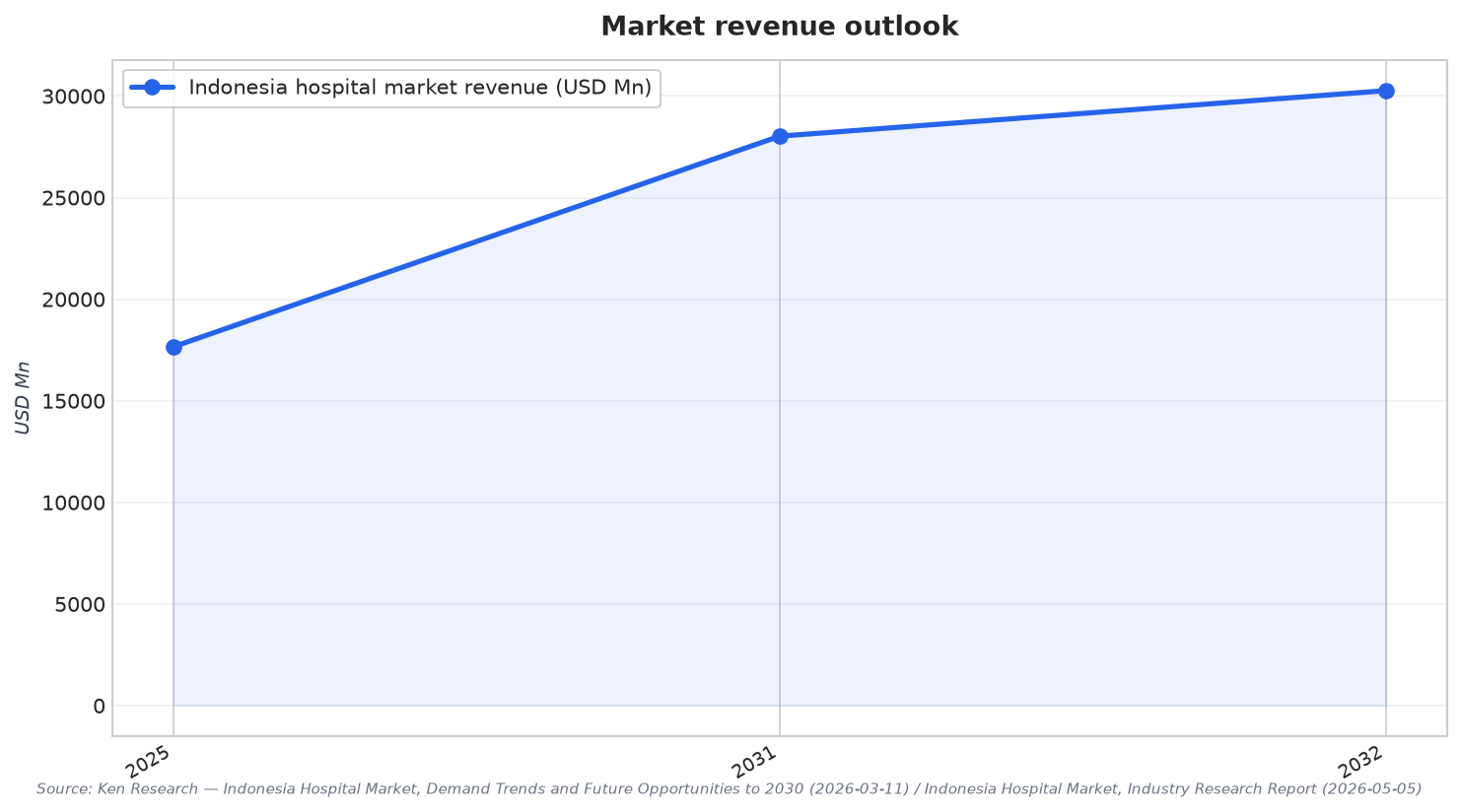
Capacity expansion is not only about adding facilities. It is also about shifting to higher intensity services. Ken Research values the Indonesia Hospital Market at USD 17,660 Mn in 2025 and projects an 8.0% CAGR during 2025–2032, reaching USD 28,025 Mn in 2031 and USD 30,267 Mn by 2032. The same outlook expects growth to outpace a modeled 4.5% expansion in inpatient admissions because revenue per episode rises with specialist case mix, diagnostic intensity, premium private capacity, and more complex cardiovascular, oncology, nephrology, and neurological treatments. This logic supports expansion strategies that integrate specialist networks and diagnostics, rather than only adding beds.
Public policy and private investment both push capacity deeper into the system. The Ministry of Health has a program to upgrade 66 regional hospitals, while private greenfield capacity and international hospital collaborations are also expected to expand addressable referral demand through 2032. However, providers still face structural gaps outside major cities. Ken Research cites that 45% of the population resides in rural and remote areas, and in 2023 there were only 1.2 hospital beds per 1,000 people, with rural regions significantly underserved. This creates a tension for chains: growth opportunities beyond Java exist, but infrastructure gaps and logistics can raise execution risk and capex needs.
Investors looking at the Indonesia private hospital market often focus on payer mix, capex discipline, and scalable care pathways. Out-of-pocket expenditure remains a constraint, with 2024 estimates showing that 32% of healthcare payments are made directly by individuals. In parallel, private health insurance demand concentrates on supplementary benefits that improve access and convenience in private hospitals. Mordor Intelligence reports Indonesia’s health and medical insurance market at USD 1.77 billion in 2026, growing at a 7.48% CAGR to USD 2.54 billion by 2031, alongside near-universal BPJS Kesehatan coverage under JKN (283 million participants, 99.34% of the population by October 2025). The investable value, then, is not only scale, but the ability to capture higher-acuity, premium-insured, and procedure-led volumes with integrated diagnostics and specialist networks.
What is driving consolidation among private hospital chains in Indonesia?
How fast is Indonesia’s hospital market expected to grow through 2032?
Why do investors emphasize high-acuity and premium services in private hospitals?
What constraints still affect access and expansion outside major cities?
What signals value for investors in the Indonesia private hospital market today?