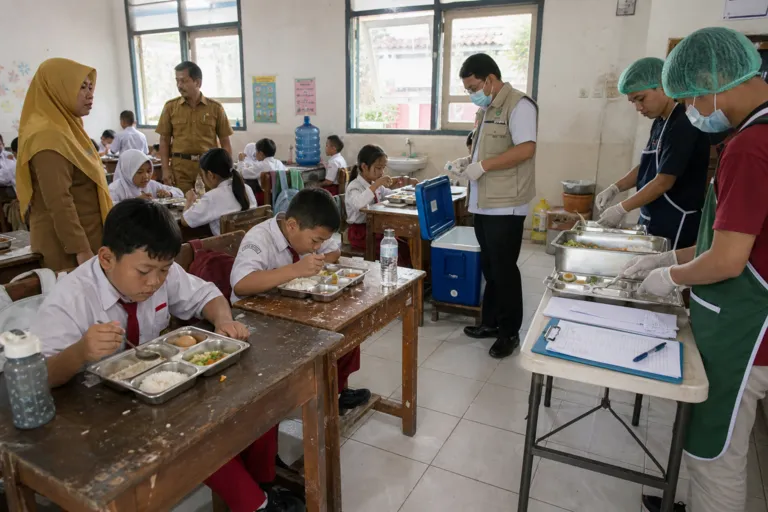
Indonesia’s Free and Nutritious Meals (Makan Bergizi Gratis, MBG) began rolling out in January 2025 and has been ramping up through 2025 and into 2026. It was positioned as a flagship “quick win” policy after President Prabowo took office in October 2024. The program is highly ambitious and aims to cover 83 million recipients, including pregnant women, toddlers, and students across primary and lower and upper secondary schools. ISEAS Perspective 2026/21 describes the design as unusually broad in both size and scope versus many school feeding programs elsewhere, which often concentrate on primary school children and may not be universal.
The fiscal scale is central to the debate over whether the Indonesia free meal program can create a multiplier effect or becomes a strain. ISEAS reports that 9% of total state expenditures were earmarked for MBG, equal to IDR 335 trillion (approximately USD 20 billion). Yet disbursement and absorption have been uneven in the early rollout. A UGM Faculty Insight piece reports that by September 8, 2025, only Rp 13 trillion—about 18.3% of its Rp 71 trillion budget—had been disbursed. Katadata Databoks adds that in Q1 2026, MBG implementation accounted for 16.5% of the budget cap in the 2026 State Budget, reinforcing the picture of a large allocation with slower-than-expected execution.
Where the Multiplier Could Come From—and What Blocks It
The economic upside narrative rests on whether MBG spending reliably reaches local suppliers and communities, rather than remaining stuck in administrative bottlenecks. ISEAS finds that perceived economic impact separates supporters from non-supporters: approval is higher among those who believe MBG is an effective development policy with economic benefits for food security and local businesses. A separate policy review on MBG highlights potential “economic opportunities through MSME integration” and “agricultural development linkages,” framing the program as more than a welfare transfer when procurement and partnerships work well. But the same UGM analysis warns that slow disbursement weakens the intended stimulus effect, since only a fraction of funds had reached local economies by September 2025.
Execution quality is the pivot point between multiplier and strain, because problems can add costs while undermining trust. UGM reports serious quality-control failures and mass food poisoning outbreaks, with over 1,000 children falling ill in West Java alone in recent weeks, and over 6,400 children impacted since the program’s launch. Investigations cited by UGM confirmed oversight and procedural lapses, including inconsistent cooking times, spoiled food, and inadequate kitchen certification; laboratory tests detected contamination from E. coli, Salmonella, and Bacillus cereus. A policy and fiscal analysis grounded in international evidence argues that while school feeding programs can improve nutritional status, attendance, and learning outcomes, effectiveness depends on governance quality, food safety, cross-sector coordination, and fiscal sustainability—conditions that become harder as the program scales.
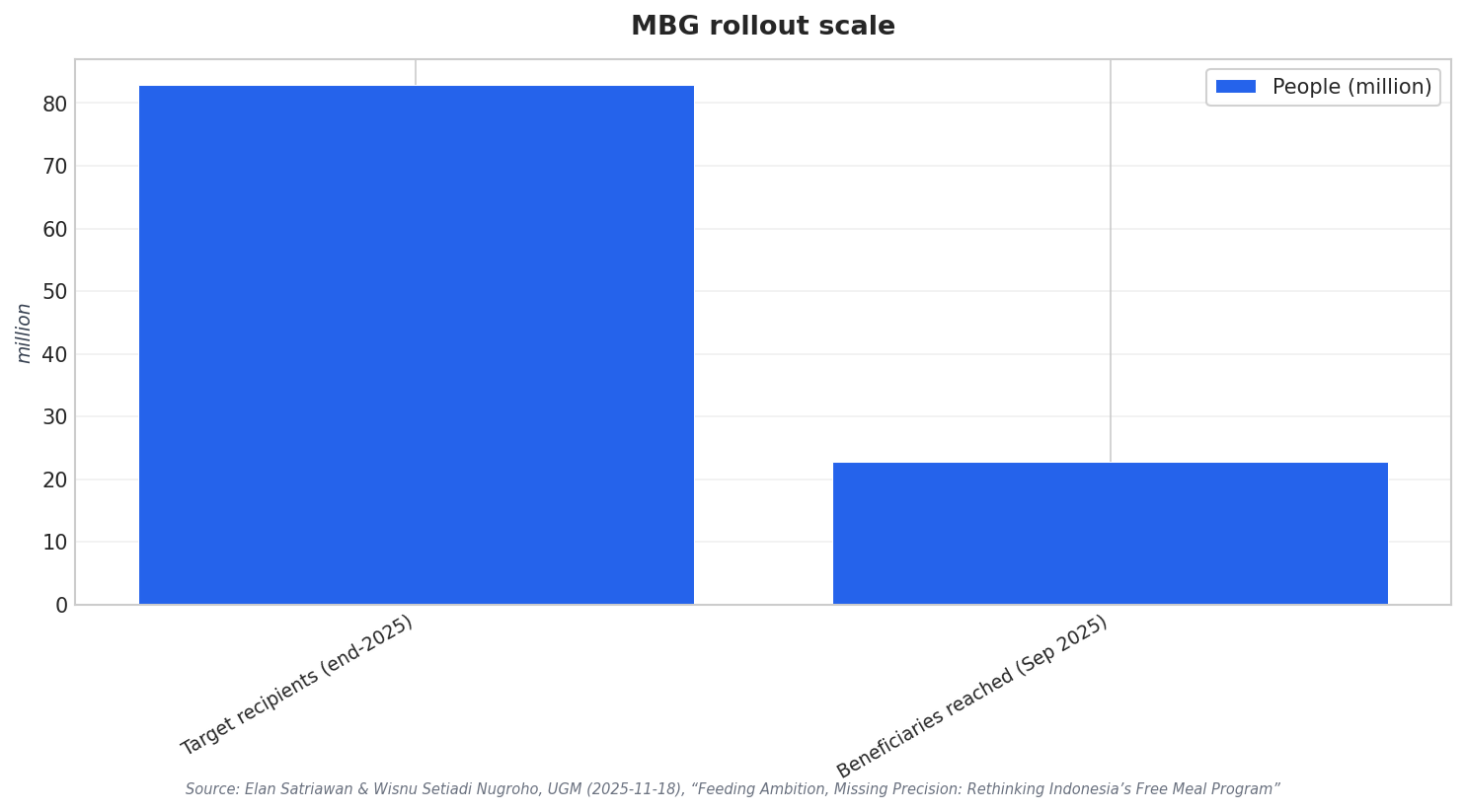
Public politics also shape whether MBG can sustain its fiscal footprint over time. ISEAS reports broad but shallow support, and documents a decline in support between March and October (no percentage is provided in the summary). The same source identifies a split between those who support universal provision and those who want better targeting; respondents with lower subjective relative income are less supportive of universal MBG and more likely to prefer targeted provision, which the authors link to concerns about fairness, misuse, and whether benefits reach appropriate recipients. In practice, the policy question becomes whether Indonesia can match the program’s scale—22.7 million beneficiaries through 7,644 SPPG units by September 2025, with targets of nearly 32,000 SPPGs and 82.9 million recipients by year-end—while tightening delivery, oversight, and spending performance enough to keep both economic and fiscal expectations credible.
When did MBG start rolling out in Indonesia?
How many recipients is MBG designed to cover?
How big is the budget footprint of Indonesia’s free meal program?
What do rollout figures show about spending and implementation progress?
What are the main risks highlighted for the Indonesia free meal program?