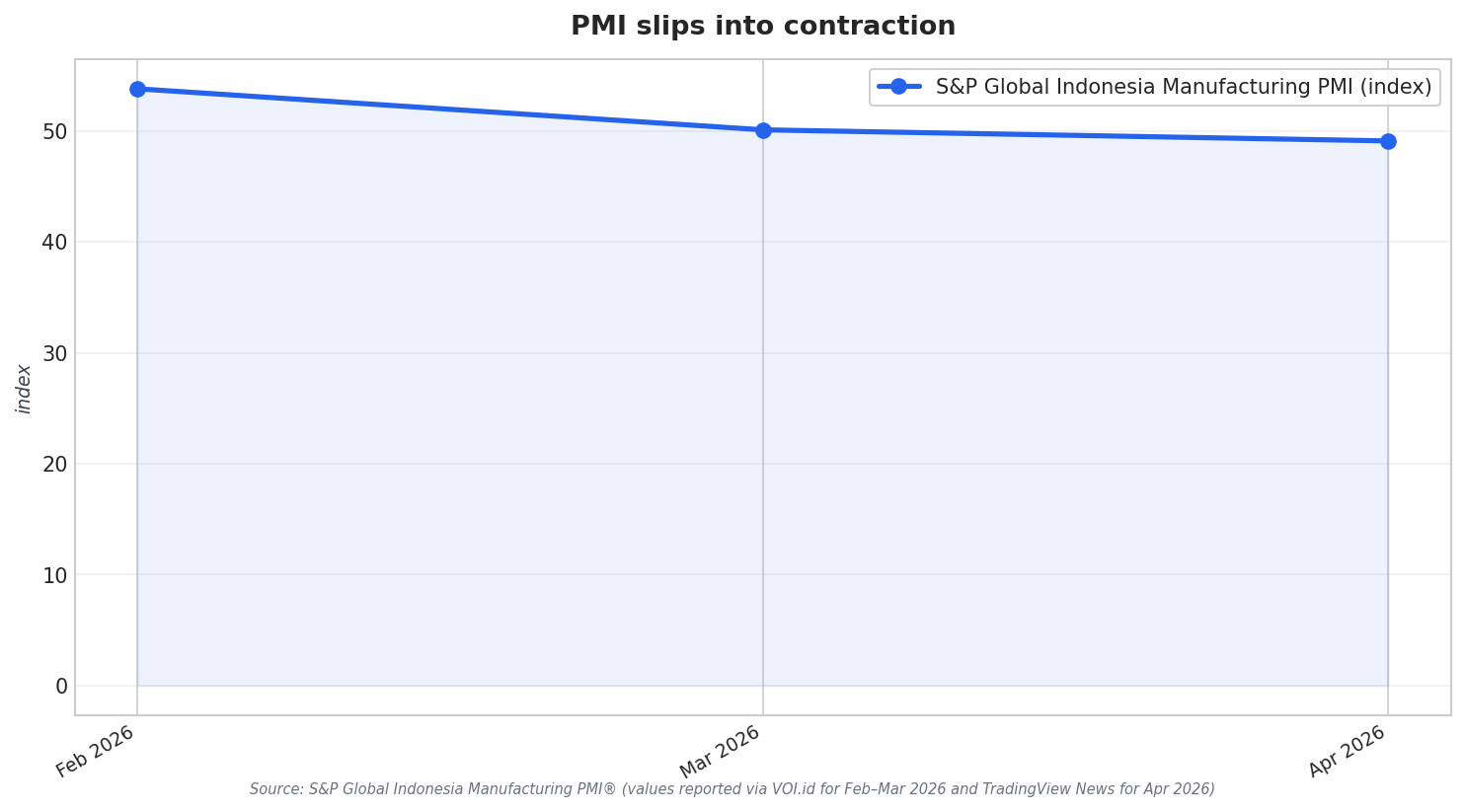
Indonesia’s factory pulse weakened fast in early 2026. The S&P Global Indonesia Manufacturing PMI fell to 50.1 in March 2026 from 53.8 in February, a move that left the sector only barely in expansion. A PMI above 50 indicates expansion and below 50 indicates contraction, and 50.1 sits on that threshold. S&P Global described the March change as “almost stagnant operating conditions” in manufacturing. This sudden deceleration set the tone for the Indonesia manufacturing slowdown narrative, because it followed a period when new orders were rising and output was growing, before conditions softened broadly.
Survey details in March help explain why sentiment shifted. S&P Global’s economist Usamah Bhatti said March data showed a renewed decline in output and new order receipts, with the sharpest decline in output in nine months. Production levels fell after four months of growth, while new demand volumes slowed for the first time in eight months. Panelists linked the downturn to scarce raw material supplies and rising material prices, which were partly influenced by the war in the Middle East and global economic turmoil. Manufacturers also cited weaker demand and increased competition weighing on new business flows, and new export orders fell after rising in February.
From Near-Stall to Contraction: What April’s PMI Added
The story did not end with March’s near-stall. TradingView reported that Indonesia’s S&P Global Manufacturing PMI edged down to 49.1 in April 2026 from 50.1 in the previous month. That reading was described as the lowest since June 2025 and signaled the first contraction in factory activity in nine months. The same update said employment dropped at the fastest rate in ten months. Read together with March’s softer orders and output, April’s move below 50 reinforced concerns that the slowdown was no longer just a brief pause, but a turn into contraction territory.
Operational indicators also pointed to easing capacity pressure, but not in a comforting way. In March, the backlog of work fell for the first time since last October, a sign that companies could complete existing work as demand cooled. At the same time, declining sales led to an increase in post-production inventories because unsold products were held as stock. Firms also reduced purchasing activity for the first time since July 2025, aligning with the view that demand and production plans were being revised down. Labor adjustments appeared as well: companies reduced labor levels twice in three months in March, even if the reported scale was small.
This is where the deindustrialization debate enters. The PMI is a diffusion index, and the closer it sits to 50, the weaker the direction of travel; the further from 50, the stronger the expansion or contraction. By that logic, March’s 50.1 was a fragile expansion and April’s 49.1 was an outright contraction signal. Still, the same March survey also recorded that manufacturers were optimistic about next year, with optimism described as strong and higher than in February, supported by hopes of demand improvement and no further escalation of Middle East conflict. Yet S&P Global also noted sentiment was below average, underscoring how exposed manufacturers felt to price and supply shocks.
What do the PMI readings say about the recent manufacturing slowdown in Indonesia?
Why did Indonesia’s PMI weaken in March 2026?
What happened to jobs and workloads as demand cooled?
Did manufacturers report any positive outlook despite the downturn?