
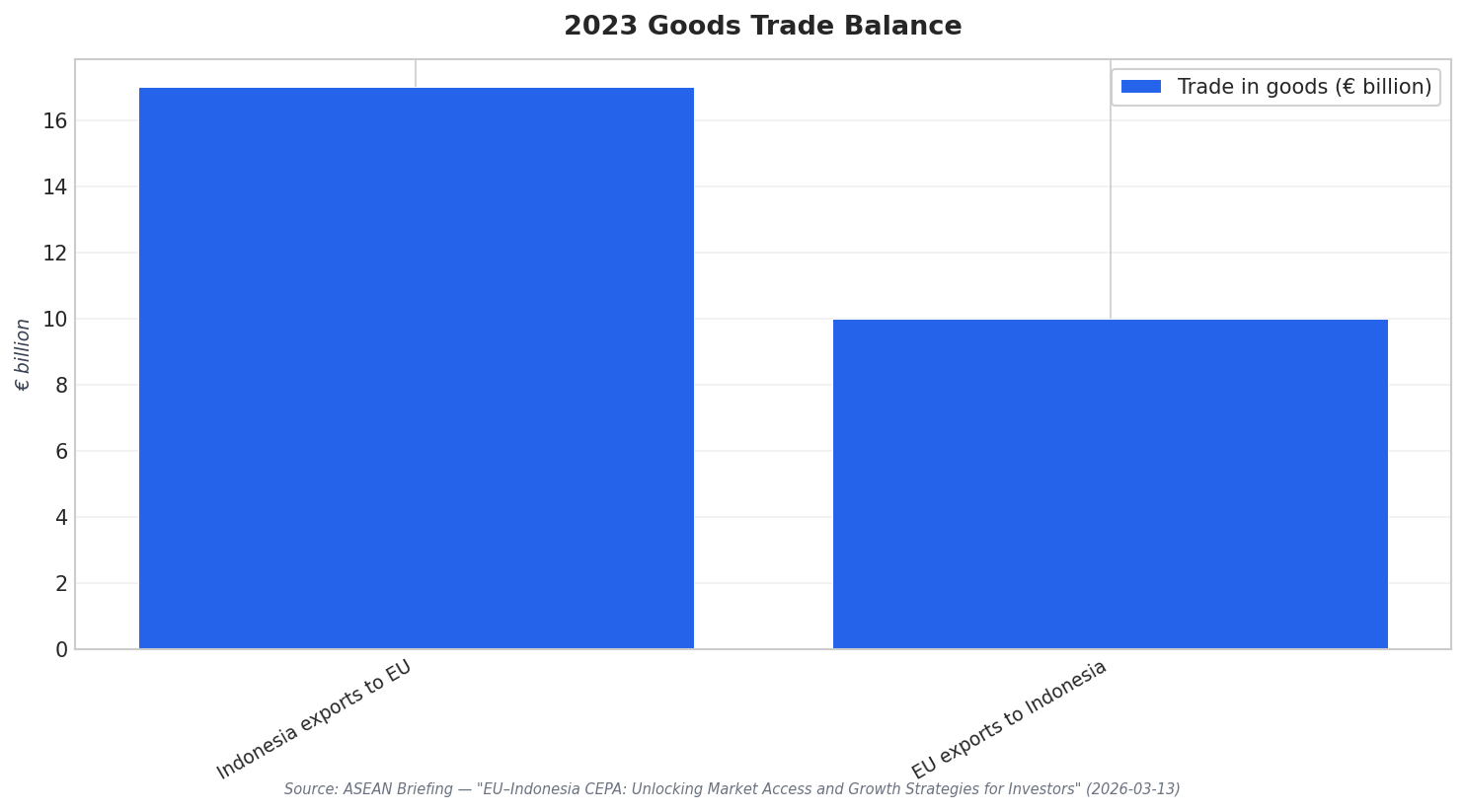
The EU and Indonesia signed the Comprehensive Economic Partnership Agreement (CEPA) in September 2025, following nearly a decade of negotiations. The agreement is built around tariff elimination on most bilateral goods, and it also sets frameworks for services, investment, intellectual property, and digital trade. In 2023, goods trade between the EU and Indonesia reached about €27 billion, with Indonesia exporting €17 billion to the EU and importing €10 billion. By 2024, bilateral trade in goods was about €27.3 billion, with EU exports valued at €9.7 billion and imports at €17.5 billion, underscoring the scale of the corridor that the new rules aim to simplify.
Tariffs are the most immediate shift. European officials said tariffs will be lifted on roughly 98 percent of EU products entering Indonesia, and the European Commission factsheet puts the tariff removals at 98.5% of Indonesian tariffs on EU goods. The same factsheet notes Indonesia’s tariffs are 10% on average, with individual tariffs up to 150%, and estimates EU exporters can save over €600 million in customs duties on goods entering Indonesia. Separately, CEPA’s tariff elimination across nearly all trade lines is expected to save European exporters more than €2 billion annually. Indonesian authorities also estimate around 80 percent of Indonesian exports will enter the EU tariff-free either immediately or under phased schedules for sensitive goods.
Which Sectors Look Best Positioned Under the Deal
On the export side, multiple labor-intensive and resource-linked sectors are repeatedly highlighted as beneficiaries as zero-tariff treatment expands. Indonesian goods expected to gain competitiveness in Europe include textiles, footwear, coffee, cocoa, and fishery products. Another CEPA summary points to immediate or phased zero-tariff treatment for about 80 percent of Indonesia’s exports to the EU, especially apparel, footwear, palm oil, fisheries, and automotive components. Additional commentary also lists palm oil, fisheries, textiles, plus some processed foods and light industrial lines as primary industries expected to benefit from tariff cuts. In practice, the winners are likely those able to meet rules-of-origin documentation and certification requirements from day one.
For European companies selling into Indonesia, the deal is framed as a major opening to a market described as 280 million consumers, alongside measures to make customs processes easier and simpler. The European Commission lists specific tariff lines where current rates are high, including cars at 50%, machinery up to 15%, chemicals up to 25%, and pharmaceuticals up to 15%. It also points to new opportunities for EU farmers, noting EU agri-food exports to Indonesia are €1 billion per year and that the agreement will remove tariffs for products including dairy, meats, fruit and vegetables, and processed foods. On brand-sensitive products, the deal prevents imitation of 221 EU traditional agri-food products recognized as Geographical Indications.
Services and investment provisions broaden the opportunity set beyond goods. The agreement liberalizes selected service sectors, including finance, logistics, and telecommunications, and the European Commission highlights openings in computer and telecommunications services. Digital trade provisions safeguard cross-border data flows and e-commerce, aiming to add predictability for fintech and cloud service providers. On investment, the framework includes fair and equitable treatment, transparency in licensing, and investor–state dispute settlement mechanisms, while also describing a more attractive regulatory environment in priority areas such as electric vehicles, renewable energy, and electronics. Ratification is not expected until late 2026 or 2027, creating a preparation window for licensing, partnerships, and compliance before competitive dynamics shift.
What is the Indonesia EU CEPA designed to change in day-to-day trade?
How big is recent EU-Indonesia goods trade, based on the cited sources?
Which Indonesian export sectors are most often cited as beneficiaries?
What does the deal highlight for EU companies exporting to Indonesia?
When could the agreement take effect, based on the sources?