Indonesia is rolling out a set of linked measures that shift both export execution and the handling of foreign-currency proceeds. On 20 May 2026, the Government issued Government Regulation No. 24/2026 (PP No. 24/2026) on the governance of exports of “Strategic Natural Resource Commodities,” and it entered into force on 1 June 2026. Under this regulation, strategic commodities may only be exported by a state-owned enterprise appointed as an Export SOE, either as owner or as sole intermediary. In parallel, a separate policy track tightens how exporters hold their FX earnings inside Indonesia, adding direct cash-flow implications alongside the new export channel rules.
In the initial phase, PP No. 24/2026 applies to coal, palm oil, and ferroalloys, with potential expansion after a coordination process led by the relevant minister. Reporting cited in the same discussion indicates PT Danantara Sumberdaya Indonesia (DSI), established under Indonesia’s sovereign wealth fund Danantara, is expected to fill the Export SOE role, although the regulation does not name the entity. The regulation is staged, requiring implementation by no later than 31 December 2026, and it is subject to evaluation within three months of entering into force. For exporters, this timing creates a moving transition window for contracting, shipping, and collections processes.
Where the Cash Flow Shock Comes From: Retention, Timing, and Treasury Friction
The cash-flow impact is not only about who sells the cargo, but also where the money must sit afterward. One analysis of the coal export overhaul describes a March 2025 regulation requiring 100% of foreign currency export proceeds to be deposited into designated domestic bank accounts for a minimum of 12 months. Another market-impact note describes a parallel policy requiring natural resource exporters to retain 100% of their foreign exchange earnings within Indonesian state banks, taking effect in June 2026. Put together, exporters face both a mandated routing layer and a restriction on where export receipts can be held, which can complicate offshore currency management for multinational treasury teams.
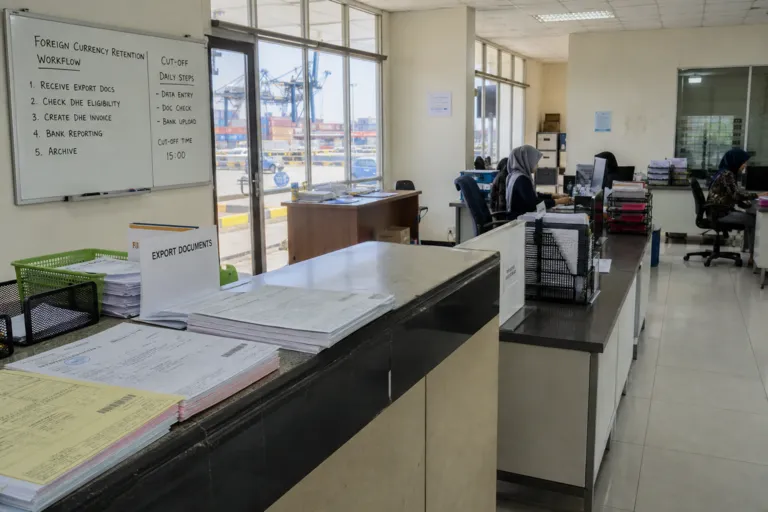
Compliance and implementation mechanics also matter for working capital. At a 1 June 2026 press briefing in Jakarta, Coordinating Economic Minister Airlangga Hartarto confirmed that coal, palm oil, and ferroalloy producers were required to begin submitting export-related documentation to the new entity from that date. The same source highlights a practical gap to watch: from June through at least September 2026, producers may be filing paperwork with an entity still building its management team. Meanwhile, contract continuity is not automatic. Danantara has stated that existing signed contracts may continue provided there is no under-invoicing, but PP No. 24/2026 itself says contracts signed before 1 June 2026 and still in effect must be evaluated by the Export SOE.
Exporters also need to track overlapping retention rules, because later changes can soften or complicate earlier “100%” headlines. A July 2026 legal update summarizes that the minimum placement percentage is reduced from 100% to 30% for at least 3 months, and that placement and IDR conversion may be made at any FX bank (not limited to SOE banks). It also notes transitional approaches, including that PPEs issued from 1 June 2026 are subject to new provisions, while some earlier PPEs under ongoing supervision are deemed compliant. For finance teams managing liquidity under Indonesia’s export proceeds retention rule, these dates and carve-outs can be as material as the headline percentage.
When did PP No. 24/2026 enter into force, and what did it change?
Which commodities are covered first under the new export regime?
How does Indonesia’s export proceeds retention rule affect exporter cash flows?
Can existing export contracts continue after 1 June 2026?
Did later rules reduce the minimum onshore placement requirement?