Indonesia is building the Merah Putih Village/Sub-district Cooperative network (KDMP/KDKMP) as a new channel that is intended to connect villages into a single economic system. IDN Research Institute describes it as a national village-level economic network backed by Rp34.57 trillion in Village Fund allocations, physical infrastructure development, bank financing, and the SIMKOPDES digital platform. In practice, the market is not one market. The same report stresses the tension between uniform governance standards and business models that must adapt to each village’s economic potential, commodities, infrastructure, and purchasing power. For suppliers, that tension matters because it shapes assortment decisions, credit terms, distribution routes, and which locations can sustain regular replenishment.
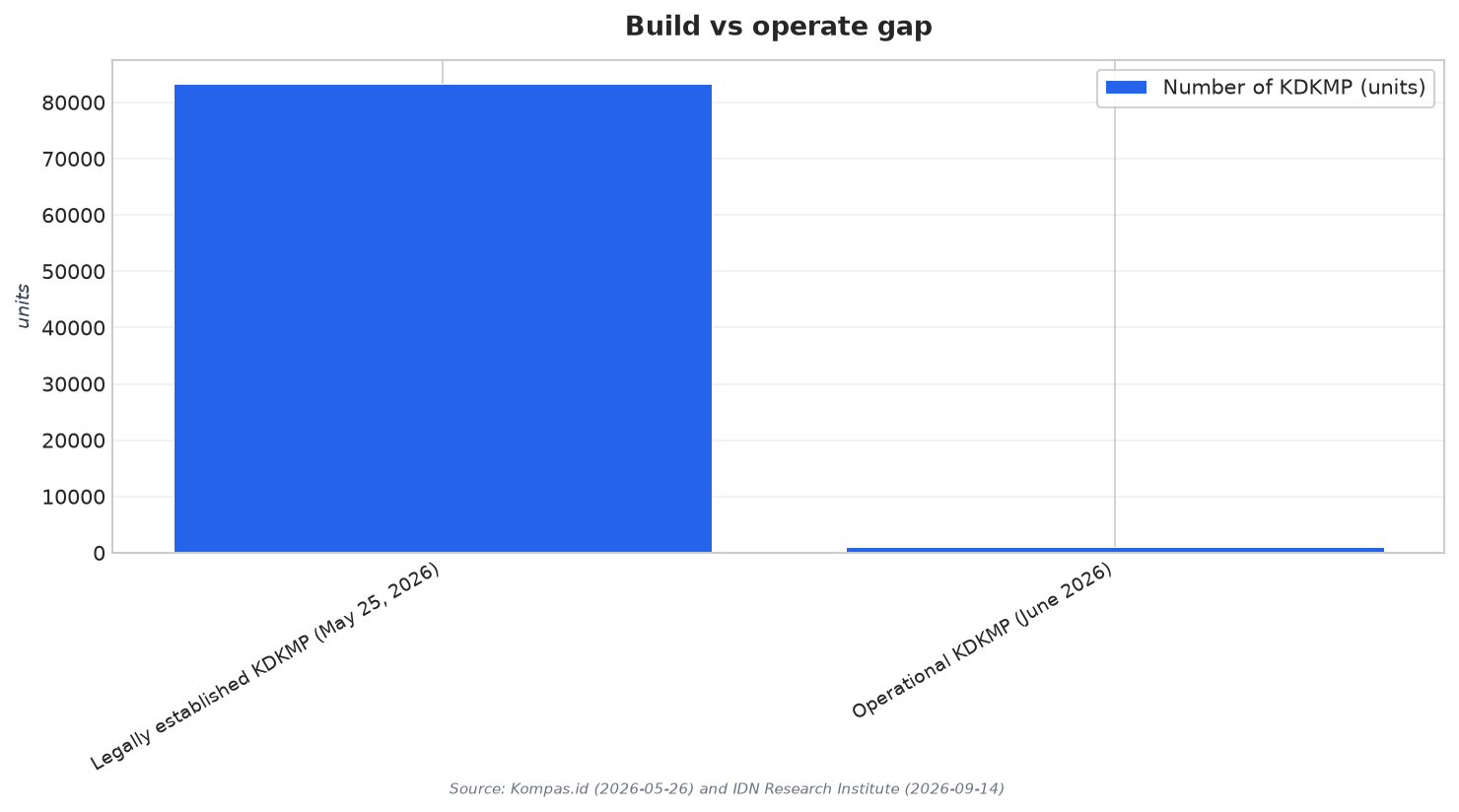
The scale of institutional formation is moving fast, while operating capacity lags. IDN Research Institute reports 83,383 KDMPs formed, but only 1,061 units were operational as of June 2026, with transactions concentrated in regions whose local economic ecosystems are more prepared. Kompas also reports 83,376 legally established KDKMP as of May 25, 2026 and notes that 1,061 KDKMP began operating simultaneously, consisting of 530 outlets in 7 districts/cities in East Java and 531 outlets in 8 districts/cities in Central Java. Kompas adds that at least 10,534 outlets had been completed, equal to 12.6% of the total registered legal entities. This gap between “legal entity” and “operating store” is where supplier planning must start.
Where Suppliers Can Win: Build for Activation, Not Just Establishment
The clearest Koperasi Desa Merah Putih business opportunities for FMCG and agri suppliers come from helping cooperatives move from administrative status to real trade. IDN Research Institute warns that counts of legal entities, NIBs, and Annual Member Meetings measure administrative mobilization and cannot substitute for indicators of actual business activity. It recommends measuring economic activation and explicitly distinguishing four statuses: established, ready, operating, and economically viable. For suppliers, that means creating segmented go-to-market offers. An “established” unit may need basic planograms and category setup. An “operating” unit may need consistent fill rates and transparent payment cycles. “Economically viable” units become candidates for broader SKUs and longer-term partnerships.
Distribution and capability are also decisive. IDN Research Institute argues that training spread evenly is less effective than training prioritized by business-model complexity, specifically citing cold storage, pharmacy, clinic, and logistics units in areas with a high Geographic Difficulty Index. That points to practical supplier moves: prioritize service levels where cold chain and logistics complexity are highest, and co-design operating routines that store teams can execute. A separate ISBEST proceeding notes that KDKMP faces competitive pressure from local retail businesses, microfinance institutions, and consumer goods distribution networks already strong in rural markets. It concludes that sustainability depends on operational efficiency, managerial adaptability, and competitiveness, with uneven performance linked to variations in business management capacity, limited human resources, and dependence on policy support.
Finally, channel engagement should reflect how the rollout is being managed on the ground. New Mandala reports that, according to the Ministry of Cooperatives, as of July 2026, 15,845 KDMP had already been built and 19,539 were under construction. It also observed sites where retail operations had commenced but shelves were half-stocked, and described cases where operations were run by Agrinas, created in 2025 and expected to manage cooperatives for an initial two years. For FMCG and agri suppliers, this reinforces the value of field execution: clear assortment logic, reliable replenishment, and practical coordination with the operating party at each site. The goal is not to treat the network as uniform, but to win the locations that are ready to transact and then expand as activation improves.
What makes Merah Putih cooperatives a new channel for suppliers?
How many KDMP/KDKMP units were operational by mid-2026?
What are the most actionable Koperasi Desa Merah Putih business opportunities for FMCG and agri suppliers?
Why is operational capability a key supplier risk in this program?
What does the build-out progress look like, and why does it matter?